Black Deer Festival Preview

Festivals, Live music, Music Review

The First {Festival} Day of Summer

In 2018 I was incredibly privileged to be able to attend more than a dozen festivals throughout the UK and Europe. Some I volunteered for as a photographer or reviewer, some as stewarding crew, but most I committed to as a regular punter. It’s taken me well over a decade to realise that I absolutely LOVE festivals. I love open air, indoor, multi-stage, single room, camping, inner city, grassroots diy, community-funded, corporate-sponsored, independent, label-driven, industry-hosted Live Music Events.

By far the most complicated event on my festival schedule last year, in terms of logistics and accessibilty, was the inaugural Black Deer Festival in Kent. Buying a ticket was the easiest part of my plan. The festival takes place on an enormous patch of undulating countryside just outside of Tunbridge Wells. Getting there from my home base in Scotland would be an epic journey by any means, however, in 2018 I was not travelling from home. The opening night of the festival coincided with my being in Berlin to see The Rolling Stones. That’s not a problem worth complaining about but it did present a few issues that negatively impacted my experience of the first festival.

My unwillingness to fly my festival camping equipment from Glasgow to London via Berlin meant a compromise in the form of a “luxury” Bed & Breakfast stay in Tunbridge Wells – exceptional accommodation for a festival in a field. (This was actually a cheaper option than taking hold luggage on my flights.) The downside to staying somewhere off-site (with an ensuite and cooked breakfast) was the lack of transport to the festival. Shuttle buses were provided for the return journey which was a great help but having read information on the festival’s website saying the location was “just a short bus or taxi ride” from the train station I, as a seasoned budget traveller, attempted to reach it by public bus. A mile-long walk across fields in the baking hot southern sun not only left my water bottle empty after 15 minutes, but meant I had another hour to walk around the perimeter of the site as I could not get access at the production entrance – my first point of contact with the festival. This was not a great introduction for me and Black Deer.

All that said, what a lovely time I had there there! It was without question my hottest UK festival weekend of the year, with a mix of outdoor and tented stages and near limitless daylight there was really no escaping the summer vibes. When the sun did eventually set on the Saturday night it painted the sky in neon orange and red as Iron & Wine played out a most beautifully chilled set on the main stage. The family atmosphere during the daytime made it feel like a bit of a play park with the added novelty of constant world-class entertainment, between the live music, food and beverage samplings, craft demonstrations and cultural displays, it was a fantastically busy and interesting place.

I can’t lie; when the 2019 line-up was first announced my heart skipped a beat. My first impressions really put this festival in the “too hard” basket. Too far, too complicated and too expensive. It was hard to imagine putting myself through that stress again for the sake of a “fun” midsummer getaway. But my lasting impressions … and that line-up, even only half-formed … I’m taking a chance; I’m going back to the park this Solstice!

There’s a bunch of artists playing the festival this year who I’ve seen before, some I’ve seen several times. A few are old favourites, particularly as festival sets go. Band of Horses headlined the first year I went to Green Man; like the novice I was I got a pitcher from the Rum Shack right on my way to the Mountain Stage and spent most of their set jumping and dancing ferociously at the back of the crowd, charging down to the front occasionally to snap a photo. The last two times I saw them live was during the summer of 2017, at Haven in Copenhagen and at End of the Road in Dorset, where Ben Bridwell held the sweetest on-stage conversations with fans in the crowd, playing requests and having the apparent time of his life. I have never seen the band deliver anything but the most joyful performances. I basically bought my ticket just for Band of Horses.

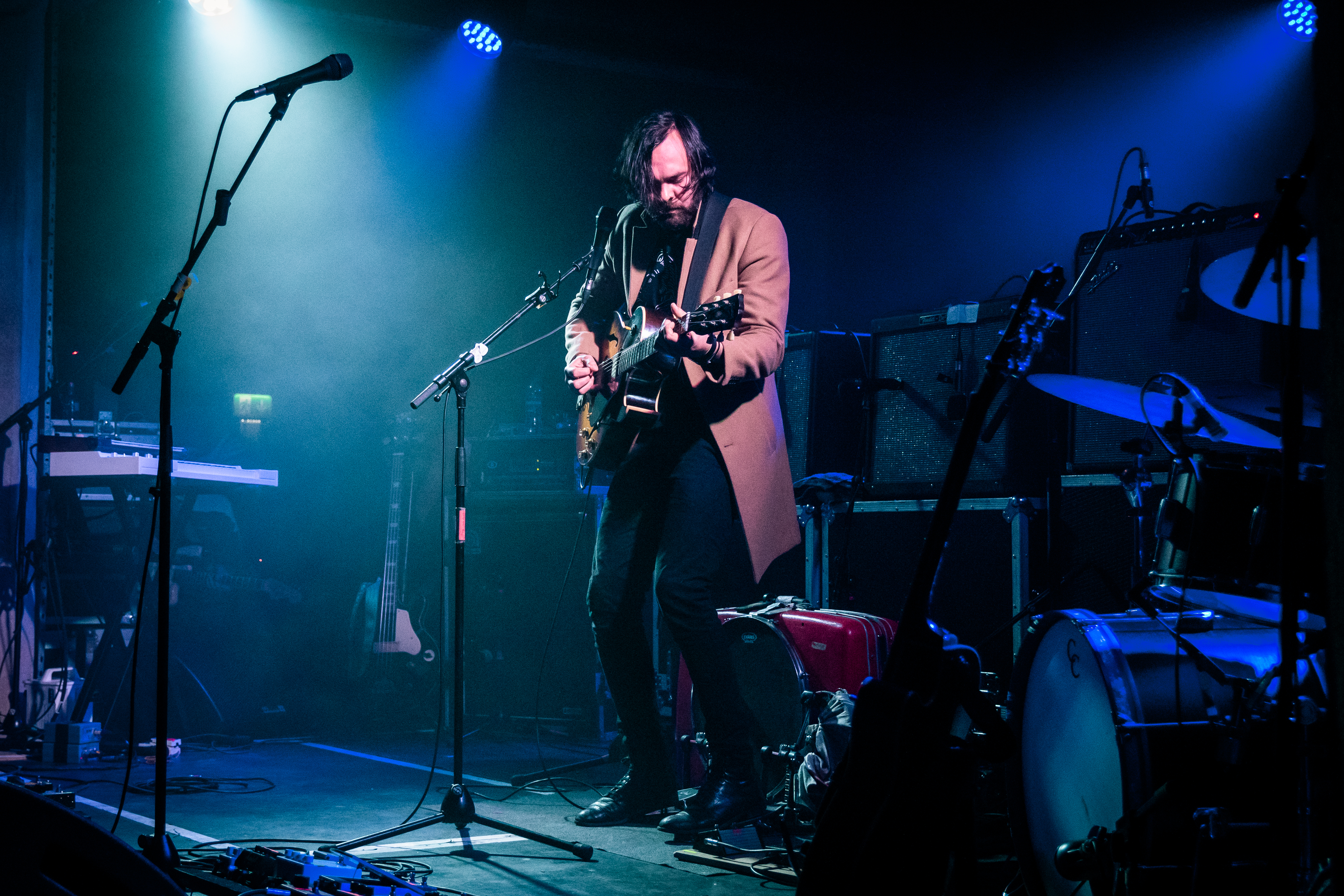
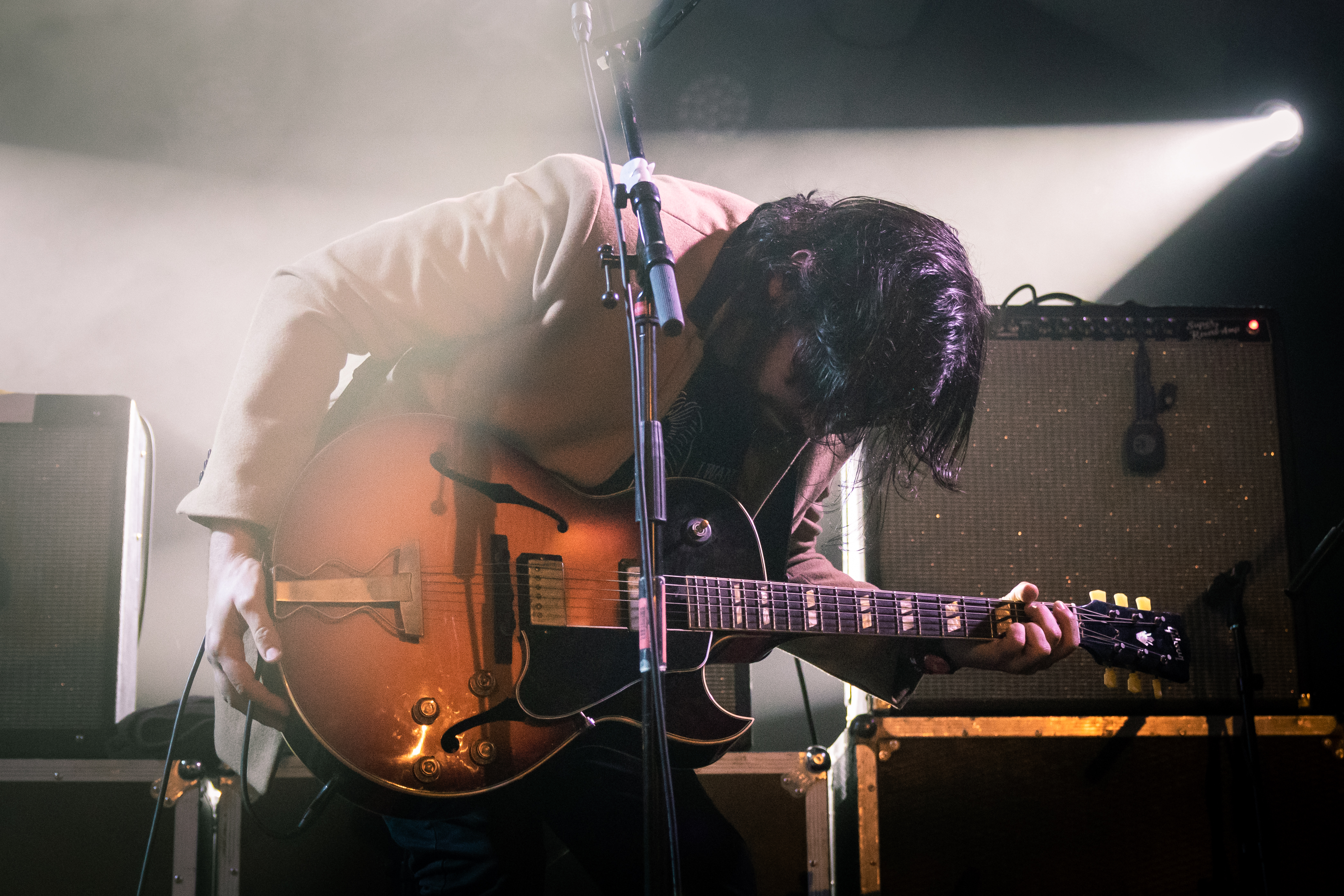
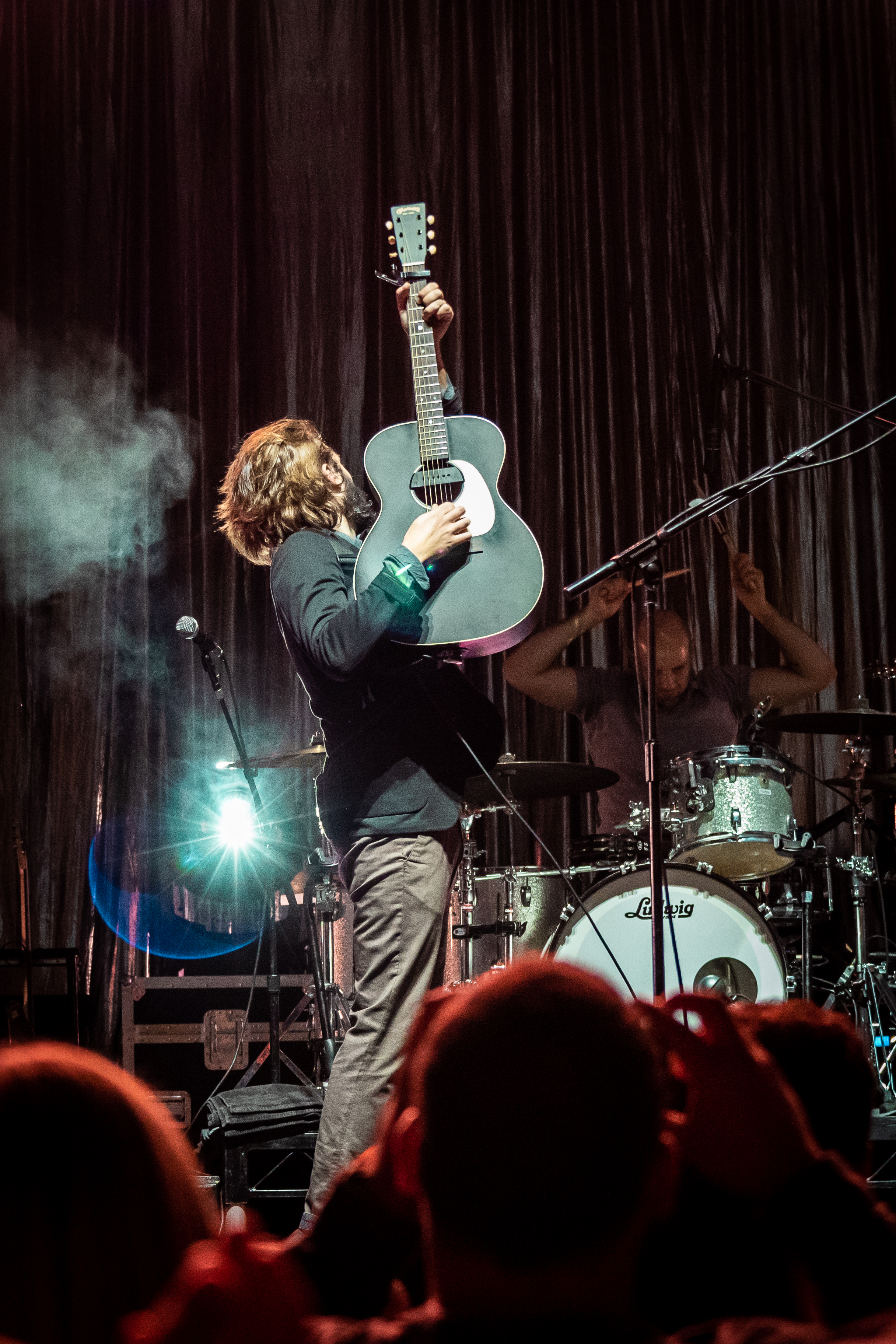
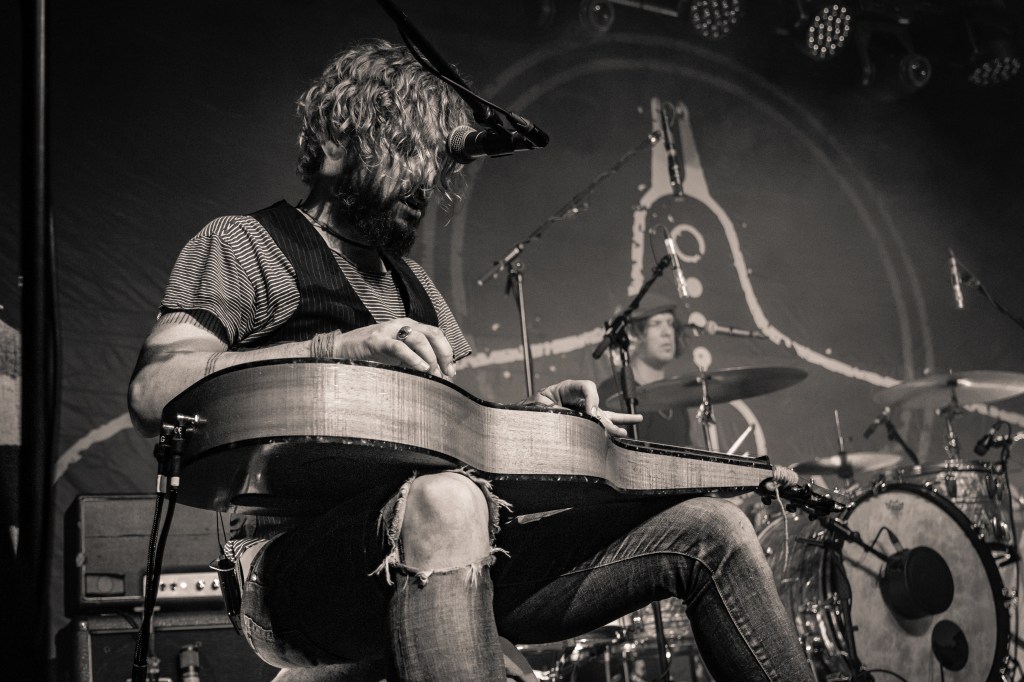
John Butler Trio are another festival favourite from my uni days when I volunteered at Groovin’ the Moo to get event management experience. I completed 3 hours of wristbanding and got to see some of the biggest Australian bands of the time. My love for JBT goes back a lot further than that though; they were the first band I ever snuck into when I was underage. When I say I “snuck”, I mean my Mum wanted to see them and didn’t want to go alone so she took me to their gig at the Yamba Bowling Club when I was 17. They played a 3-song encore that lasted around 30 minutes (1 song was an 18 minute epic)! My tiny mind was blown and I’ve been an awe-filled devotee ever since. I’m hoping for similar weather to last year to create a really authentic Australian heat in their performance.

In early 2011, at my first Celtic Connections festival, I stumbled upon the unfathomable magic of The Staves. I followed them obsessively from that first encounter and they were responsible for introducing me to one of the biggest influences on my musical taste in the last decade; Communion. They also provided the soundtrack to one of my favourite roadtrip memories; driving across Tennessee from Knoxville to Lynchburg and on to Memphis, in early winter when “Dead & Born & Grown” had just been released. That album, to me, is quintessential English Americana and it makes perfect sense to see them high up on the bill at Black Deer. Always good fun, down to earth people but completely surreal performers.

If I’m going to talk about incredible performers and “English Americana” then I have to mention Yola. “Walk Through Fire” is going to be on every “Best Of” list this year. The songs on this album are deeply personal and that comes across in Yola’s delivery each time; she means every word, but they’re also extremely listenable. Yola treads a fine line between being absolutely unbelievable and completely relatable, and the live setting is where she connects those identities in front of the audience. Her voice is more powerful and her personality more raw when she’s on stage and I adore being in the crowd when she goes to work. Paul Cauthen is another force of nature when it comes to live performance. He doesn’t need to play up his smooth Texas accent to make you weak at the knees, it’s all there in the boom and bass of his voice. He draws on soul, gospel and traditional country with little sparks of southern rock, funk and R&B thrown in; it’s a heady blend, man! Irresistible.

There’s some big names on the bill, some actual legends, and I’m obviously not going to miss those artists but one of the best things about festivals, for me, is the “discovery” moments. Martin Harley was one of mine at Belladrum last year so of course I’m thrilled to have another chance to see him play. Lucy Kitt impressed me with an early afternoon set at Ramblin’ Roots Revue in April and again at Red Rooster Festival earlier this month. I’ve lost track of how many times someone has asked me “Do you know William Crighton?” over the years. I don’t know him. That is to say, I’ve never seen him live. I don’t even know how it happened but I’ve been following The Hungry Mothers online for a while now and I’m excited to see what they bring to the stage.

Really, there’s too many highlights to mention right now, and it’s all futile speculation pending some kind of timetable, but needless to say I’m very excited for this year’s instalment of Black Deer and I’m looking forward to a smooth journey in and out of that faraway park in the deep south of England. There’s nowhere else I’d rather spend my first days of summer.
Idlewild – Aberdeen Music Hall

Live music, Music Review

On the weekend that Idlewild released their latest album Interview Music they played 3 separate sets in Aberdeen; two at the AECC for the BrewDog shareholders’ AGM and one semi-acoustic instore at HMV. Whether by coincidence or by design they also rounded out the UK leg of their Interview Music tour at the city’s recently transformed Music Hall on Sunday night with a rousing set of modern classics and old favourites.

The XCERTS had the privilege and responsibility of getting the bank holiday crowd warmed up for one of their own favourite bands, which proved to be more than within their capabilities. The three-piece, originally from Aberdeen, have been sailing a sea of praise since their fourth album Hold On To Your Heart was released at the beginning of 2018. Their unapologetically ripe blend of instantly sing-a-long-able choruses, almost-familiar riffs and heart-on-sleeve lyrics on this album and subsequent out-takes EP, Wildheart Dreaming, seem to connect with even the grittiest of old school Idlewild supporters. There’s no denying Murray MacLeod’s stunning vocal is the centrepiece of these songs; whether rocking out on upbeat openers Daydream and the Petty-esque Drive Me Wild, or crooning through piano-lead power ballad The Dark, his delivery is loaded with melodrama and earnest romanticism. The ten-song set rushes by to close with the irresistible a cappella chorus of Feels Like Falling In Love. Job done. The crowd is suitably thawed.

Following a career highlight tenth show at the Barrowlands in Glasgow the night before Idlewild seem astonishingly relaxed when they take to the Music Hall stage. Their energy and resolve is not diminished any by the previous night’s antics however and they set straight to task bringing Interview Music alive for their assembled followers. Dream Variations introduces the new album straight away with equal measures of everything this band is about in 2019; a rock-solid rhythm section, duelling guitars and piano, soaring harmonies and, of course, Roddy Woomble’s abstract lyricism. A curious feature on the new album that comes into play further as the set progresses is the mid-song change-up; a different tempo, a different energy, new melodic ideas break through. The title track takes one of these moments to catch its breath before launching an all out sonic assault. It’s not out of place, more a reminder that the band still love to jam, still love to throw everything into their performance.

New songs are few and far between, for being an album-specific tour, but where they do come they’re well received by the Aberdonian crowd. Woomble points out that the record sold particularly well in the city, so it’s unsurprising to see so many people singing along. Radio single Same Things Twice sees fists in the air and voices raised as if it’s been in the set for the last decade. Admittedly, it has one of the catchiest choruses on the new album, and live it takes on a coarseness and density to rival anything off 100 Broken Windows. Indeed songs like Roseability and Little Discourage elicit spontaneous pitch perfect sing-a-longs and the crowd need little prompting to join in when Woomble says he’s needing support on Live In A Hiding Place. Another mid-set highlight is the frenetic and angular A Ghost In The Arcade. Washed in strobing green, white and blue lights, it closes with a rambunctious solo from guitarist, Rod Jones, and finds Woomble watching on not from his usual shadowy side-of-stage vantage point but from the front corner of the stage; an indication of just how relaxed he is within the performance.

From the point of American English the set takes off on a melodic upward trajectory, buoyed by the crowd and reciprocated by the band. It leaps from El Capitan to yet another reworked rendition of the fan favourite When I Argue I See Shapes, altogether faster and fuzzier than on the previous tour but still not as messy as the original. This could be its best incarnation yet.

The band wave a brief “thank you and goodnight” but don’t waste much time before returning for their encore. They still have a lot to deliver but spare some grace to introduce the first song, in tribute to Scott Hutchison, a cover of the gut-punching Frightened Rabbit anthem Head Rolls Off. It’s powerfully uplifting from start to finish, leaving many faces scorched with defiantly jubilant tears. The encore is relentless rock after that, wringing out every last ounce of love from either side of the barrier. As if the band had something to prove. Finishing with In Remote Part / Scottish Fiction there’s still a sense that the band could come back for a second encore and the crowd are restless and demanding until the house lights finally come on. It’s enough, for now. They’ll probably be back; seems they quite like playing Aberdeen. And they would be welcome, any time.

Travis; The Man Who 19th Anniversary – SSE Hydro

Live music, Music Review

You don’t need an excuse to listen to Travis’ 1999 sophomore album The Man Who; it’s a beautiful, timeless record loaded with endearing melodies, vibrant acoustic guitars and po-faced love songs. It’s the sort of album you listen to because you still like it, because you can’t remember a time when you didn’t like it, and probably because you can remember a time in your life when it didn’t exist and that time wasn’t as good. It’s polarising in that sense; life before and life after The Man Who. Music before, and music after. If you’ve welcomed this album into your life then you know what I’m talking about. Released in the wake of Britpop when pastiche was less of a trend, The Man Who marked a turning point, or at least a dividing line, in pop music. Without any knowing guidance, and despite being sonically informed by Oasis at the time, Travis came to define the sensitive sound of the four-piece male rock band at the turn of the century. Their iconic songs, loved or loathed, dominated radio the world over and lead the way for so many bands to follow from Coldplay through Snow Patrol and up to Mumford & Sons.
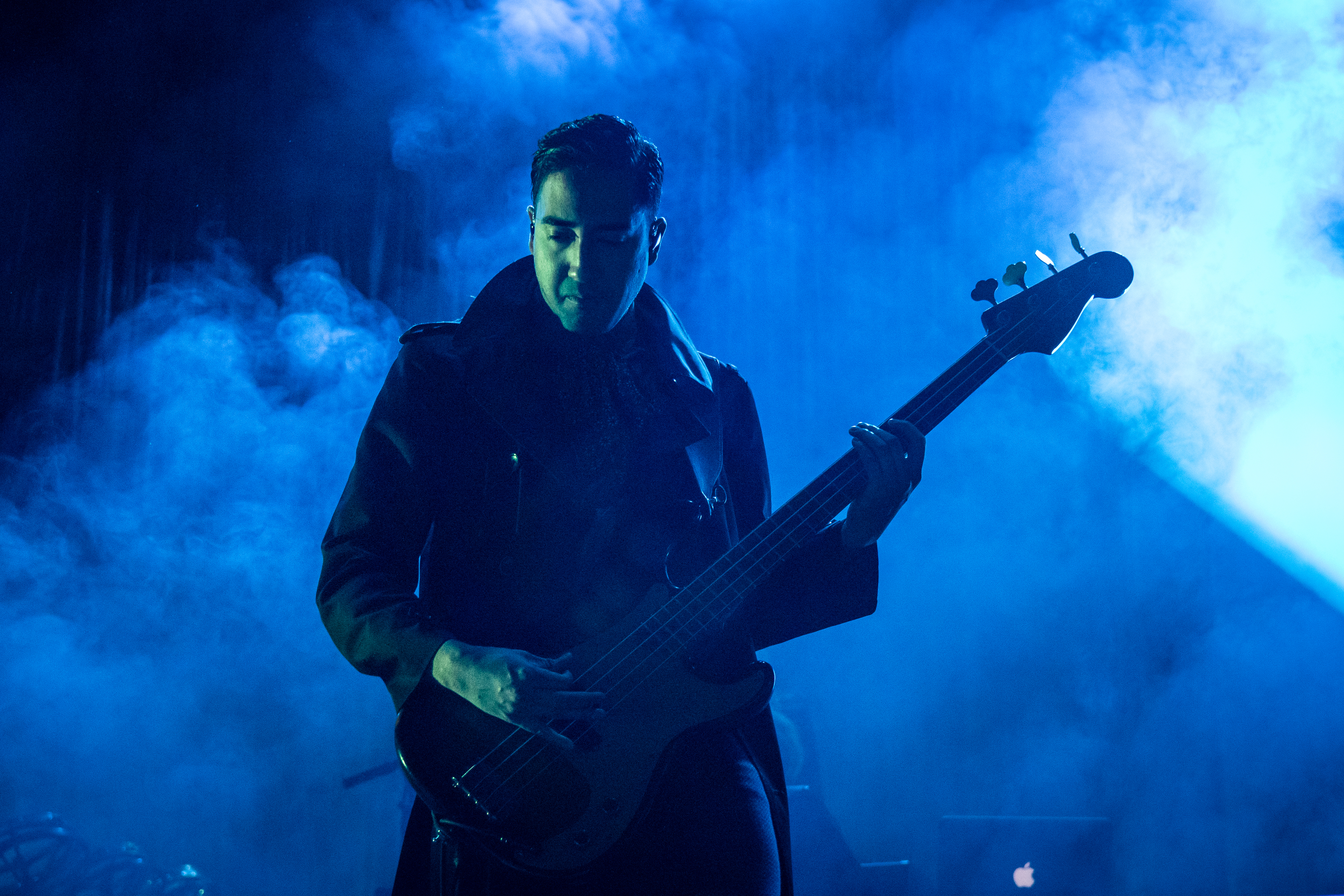
In light of this then, Travis themselves need no excuse to celebrate and tour the album that launched them into the pop-rock stratosphere so many years ago. 19 years ago, in fact. 19 is not a significant anniversary but The Man Who is a great album so why not? Fans want to hear it, the band want to play it. The music economy doesn’t get simpler than that these days. A run of shows earlier in the summer took in numerous venues across England, as well as some festival slots, so the final two-weeks of 2018 bring them around again and home to Glasgow’s SSE Hydro just in time for Christmas, and 2 years to the day since they last played here on the Everything At Once Tour.

Isle of Lewis singer songwriter Colin Macleod released one of the year’s best albums in Bloodlines and as the first of two supports for the night he delivers stripped back renditions of five songs from the record, as well as a melancholy interpretation of Ring of Fire. Beautifully understated and delicate from beginning to end, his set feels naturally calm amid the excitement and anticipation of the evening. He concedes his own disbelief at opening the show, admitting that Writing To Reach You was the first song he ever played. Right now though his own songcraft is fully matured and his confidence on stage serves him well, alone in the spotlight.

The second support are relative “old favourites” of Travis’ audience, and certainly owe a debt to the acoustic rock path paved by The Man Who. That said Turin Brakes have never stood in the shadows and since touring with Travis in 2001 they have remained friends and contemporaries, not rivals. Their divergent musical roads couldn’t be better exemplified than in tonight’s performance. A 10-song set draws from across their catalogue, never focussing heavily on one period and certainly not trading on nostalgia, but rather offering a cohesive sonic representation of where the band are now. And it’s a great sound. They’ve always been known to indulge their rock tendencies in the live setting and tonight is no exception. They’re clearly having a lot of fun; whether it’s because they’re out to impress as a support act, or because they don’t have the pressure of headlining, it doesn’t seem to matter, their performance is top shelf. Older hits like Painkiller and Underdog are reworked with fresh intros and some mint distortion on the acoustic guitars. If anyone walked in during Black Rabbit expecting a Travis concert they’d be very surprised by the rambling proggy jam happening on stage. It keeps on the sunny side of excess though and the band are sent off with just the appropriate level of enthusiasm ahead of the main act.

I want to be objective about what happened next but there’s an obvious reason I bought a ticket for this show. Here instead are some facts about the gig:

Between support sets Fran Healy came out to the barrier and met fans, shook hands, posed for photos, signed things, chatted to people.

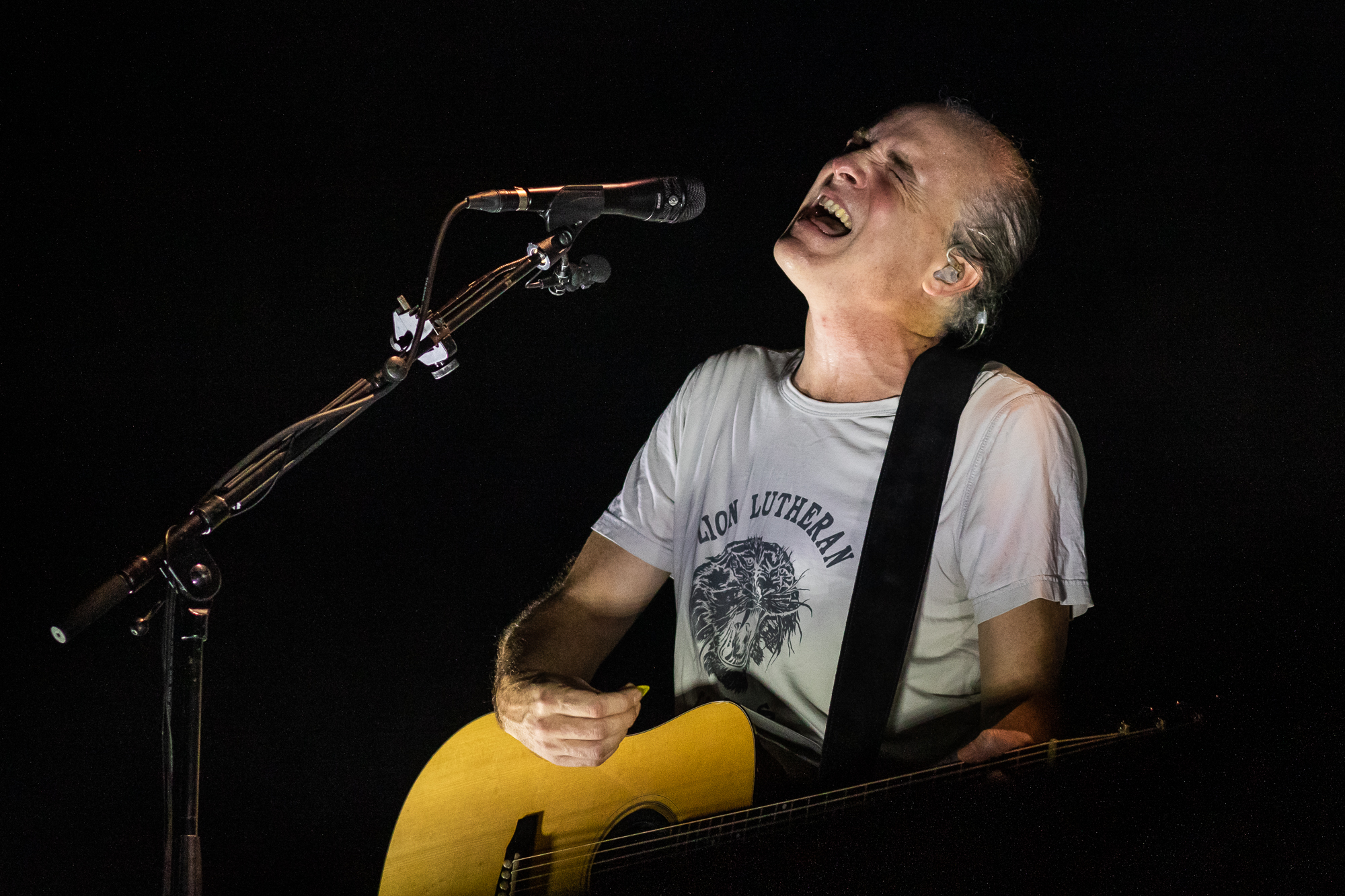
On stage Fran wore a kilt and a “Zion Lutheran Cougars” t-shirt identical to the one he wore in the video for Why Does It Always Rain On Me?

Andy Dunlop got very sweaty, very quickly.

Dougie Payne smiled a lot.

The band played The Man Who from start to finish, including its hidden track Blue Flashing Light, and then left the stage.

The second half of the set comprised a “best of” selection of singles and closed with a Christmas medley, accompanied by a couple of brawling jakey Santas.

But what was it like? Well honestly, it was pretty special. The nature of a start to end album show is that inevitably a band has to play their hits as they lie, i.e. Driftwood, Turn and Why Does It Always Rain On Me? went out in the first half. It’s unorthodox to play your biggest single in the first hour of your show and it felt a bit strange to be pogo-ing  so early in the night but the other side of this is that the band get to play some songs that otherwise wouldn’t make it onto the usual setlist. I haven’t heard Last Laugh of the Laughter in years and the harmonies were sweeter than I can ever remember. It was perhaps the only song that sounded different from the album version, and only because of the strength of the backing vocals, the rest was very true to the original sound. Another take on this format is that some of the band’s more challenging songs also have to come out. Much as they might be endeared to the hardcore fandom moments like Luv and She’s So Strange were reminders of why The Man Who was critically derided as a collection of “sad” “ballads”, the latter in particular proving a bit of a stretch for Fran’s vocal chords. But there were fond memories and pleasing anecdotes to go along with these old songs and the band have never lost their wondrous humour which always keeps their live shows so engaging and entertaining.

The second half of the set highlighted a few other things about The Man Who. Firstly, that the significance of the album to fans cannot be understated; once upon a time these were some of the only Travis songs in existence and they were adored mightily and whole-heartedly which, in the context of the live show, means the album falls so naturally and familiarly on the ears that it sounds like a “best of” in itself, even up against the established singles like Side and Closer. Every song is so well received. Secondly, that Travis’ true nature has always been as a rock band. From the opening chord of Blue Flashing Light the atmosphere in the arena is completely changed, electrified, amplified. The Man Who happens to be a cohesive collection of quiet songs and there are many others in the catalogue (see The Invisible Band) but when given a platform, or an entire half a set, the band choose to play loud, choose to rock out, choose guitar solos, choose to traverse the stage, choose to jump off the drum kit. The Man Who is another side to that band but it was never the limit of their abilities or interests. Lastly, that Travis are a band from Glasgow and were they not, they would never have written as iconic a song as Why Does It Always Rain On Me? because where else in the world could they have found inspiration in the best audience of voices to belt out such an anthem?

Jeff Wayne’s The War Of The Worlds – SSE Hydro

Live music, Music Review

As a young child I visited the cassette drawer of my parents’ entertainment unit regularly. It contained so many treasures; a selection of Neil Diamond albums; various ABC Radio compilations; a cleverly duplicated copy of the Young Einstein soundtrack; the all important head-cleaning tape and fluid pack and multiple anti-static cloths for our records. Buried in the back right-hand corner, presumably because it didn’t fit the individual slots of the cassette trays, there was a double album that intrigued me for a long time. When I finally enquired with my Mum about this block of tapes – I hadn’t seen a double album on tape before, it was a block – she related to me the story of how The War of the Worlds had been broadcast as a radio play in the 1930s and caused mass panic, even alleged suicide, because people thought an alien invasion was taking place. I found that story absolutely terrifying. From then on I regarded that double album with a kind of universal fear that I couldn’t even understand.

I must have been about 10 or 11 years old the first time I felt bravely curious enough to listen to that album. The album was, of course, Jeff Wayne’s Musical Adaptation of The War of the Worlds: Not nearly as terrifying as an American radio play adapted from H.G. Wells original invasion novel. Or so I told myself. You know that way frightened children rationalise with themselves about the dark? “There’s nothing to be afraid of” I told myself as the notorious “Ullas” sounded. I nearly survived Tape 1, Side A before turning it off. I made several more attempts but couldn’t get my stomach beyond the notion of that chorus; “But still, they come!”

When I was a little older, maybe 14 or 15, and in the prime of my teen horror film phase I discovered this album again in the record collection of my best friend’s parents. Late one Saturday night while sleeping over with a couple of other girl friends, after a binge of scary movies, we decided to put it on. This time I got all the way to turning over to Side B and was just about to drop the needle when one of the others girls interrupted, “Do we have to? I really don’t like it; it’s scary.” We let it go for the night and later, when it was just me and my best friend, we played Side B. But by the end of that we were bored. The musical themes were still dramatic and frightening, and the narration eerily haunting, but in the light of Sunday afternoon it just didn’t seem as interesting.

It was a long time before I revisited TWOTW, it was on the same long haul flight where I first listened to Mike Oldfield’s Tubular Bells in full. I had some time to kill. In the confines of the plane I drifted in and out of consciousness and in and out of the nightmarish commentary. When I eventually came around for a meal service the album was somewhere in the middle of its third or fourth repeat, so I can definitely say I’ve played it all the way through. In my memory though it’s still a terrifying listen. Even the titles of the songs/chapters give me chills; one mention of a “heat ray” and I get that sinking feeling in my stomach. There’s no question in my mind: It is a masterpiece! A truly haunting masterpiece.

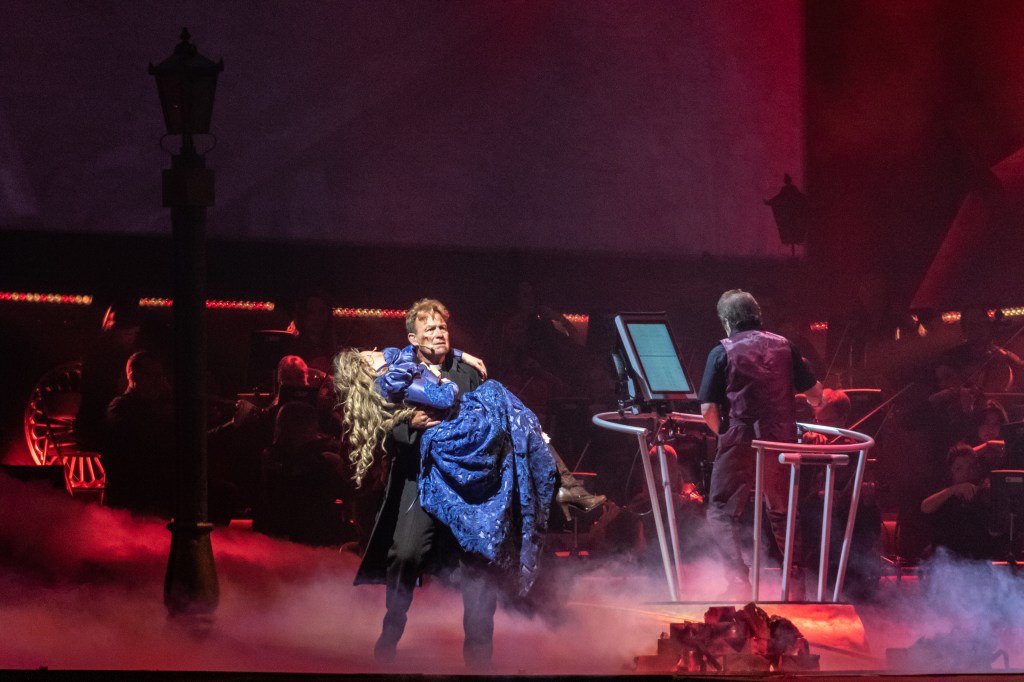
Never in all these years did I imagine seeing a live stage production of something that so traumatised me as a child. Yet, when the 40th Anniversary arena tour was announced I knew I needed to see it. I could think of no better way to experience this album than in a vast chamber with enormous light and sound capacity, surrounded by an audience of thousands. Yes, this would be the perfect environment to conquer my fear of the “Fighting Machines”.

I had no idea what to expect and for my own enjoyment, or perhaps torture, I didn’t look into the previous stage productions. I wanted to engage with the performance, fresh and naive, like I had done with the album. And really, I did. At first the simplicity of the set appeared disappointingly dull.

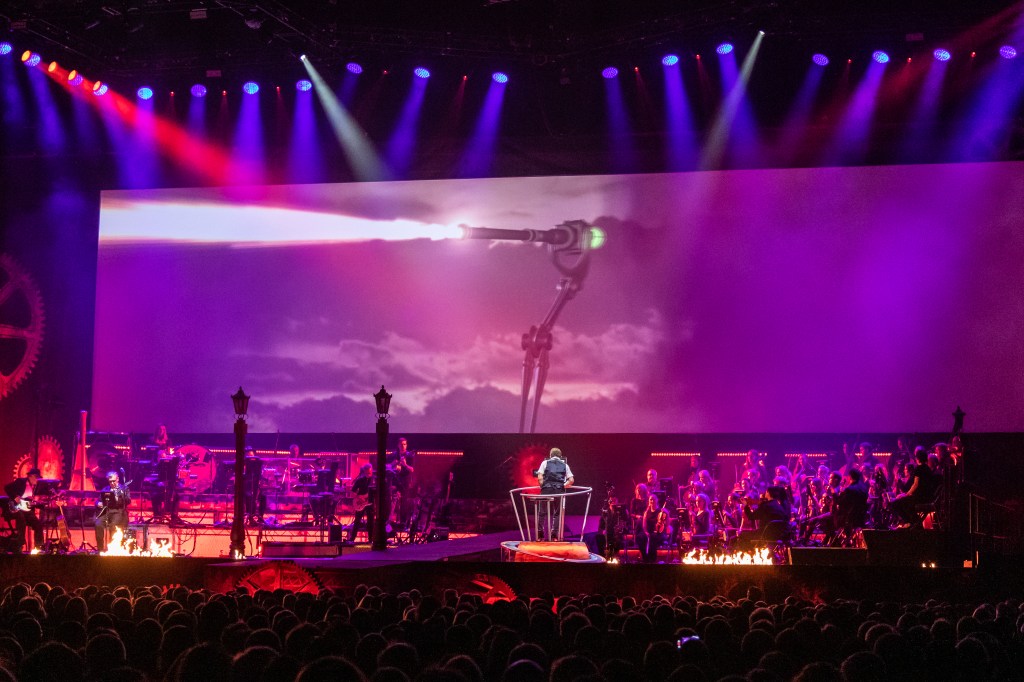
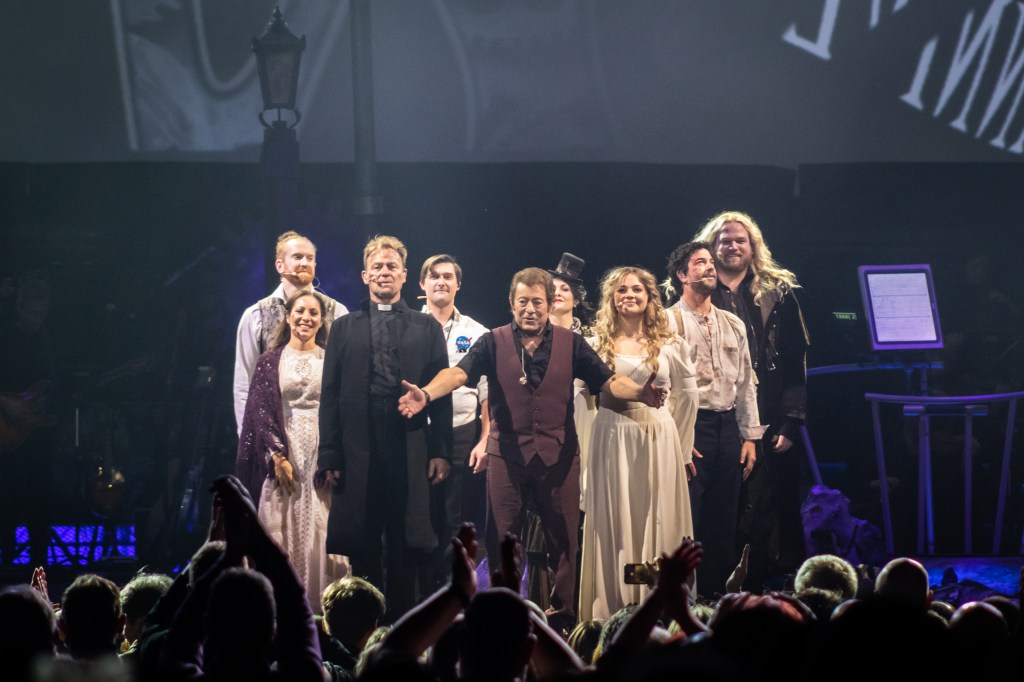
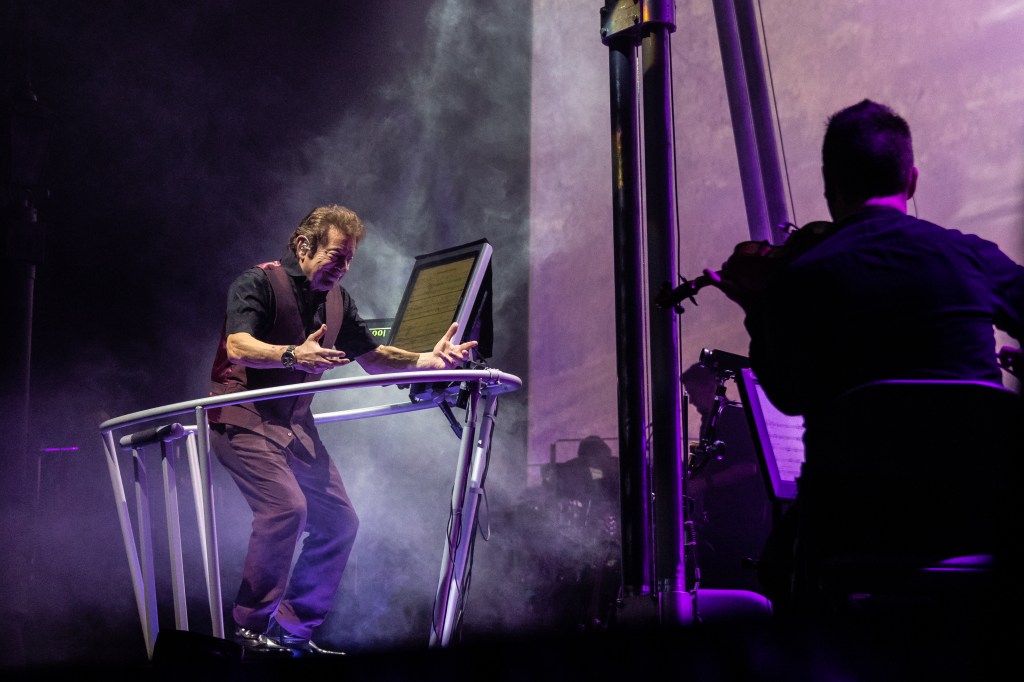
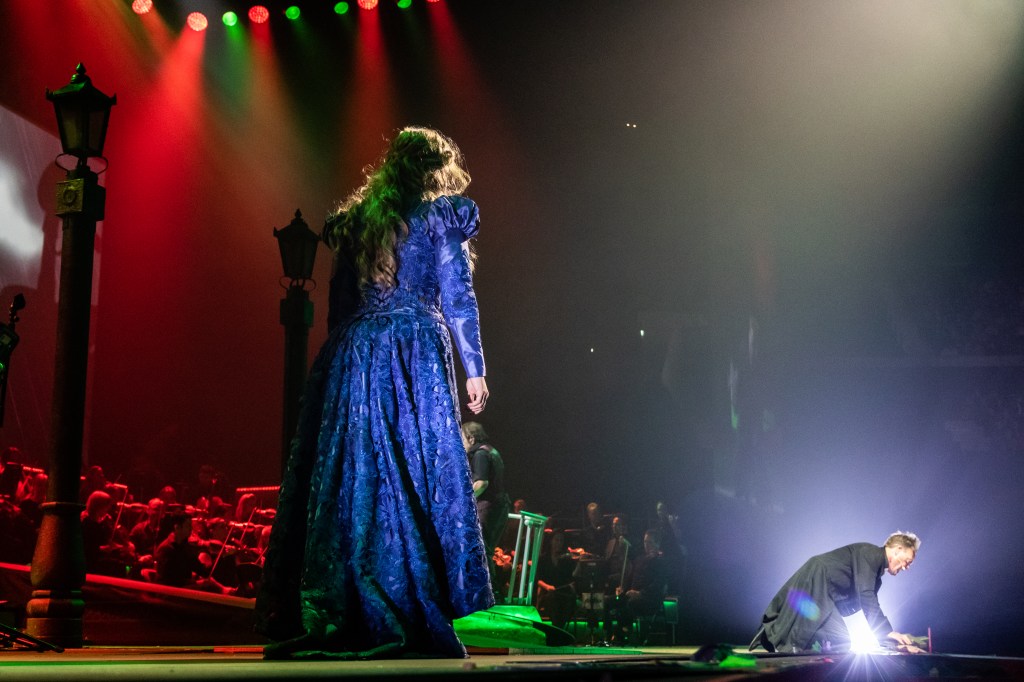
A ramp from the back of the stage running between two lamp posts lead the actors into position in front of the band, string orchestra and conductor, while a secondary stage in the centre of the arena was bare. However, as my eyes adjusted to the contrasting light from the large screens behind and on either side of the stage I began to see the finer details. Giant cogs, metal discs, scaffold railings, beams and pillars, adorned the stage surrounds with an industrial charm.

The musicians were often silhouetted but occasional highlights would reveal some glamorous fabrics. The cast, as they featured one-by-one, or at times in pairs, were all fully characterised by their respective wardrobes. And the visuals projected on the screens were loaded with detail and stimulation, particularly fitting to the pace of the narration. In some moments of intense action the density of the production was nearly overwhelming; there was so much to take in. A street scene of destruction featuring “Jeff’s Music  Emporium” was one of those moments where your eyes could have been watching anything and you would have seen so much, but missed so much at the same time.

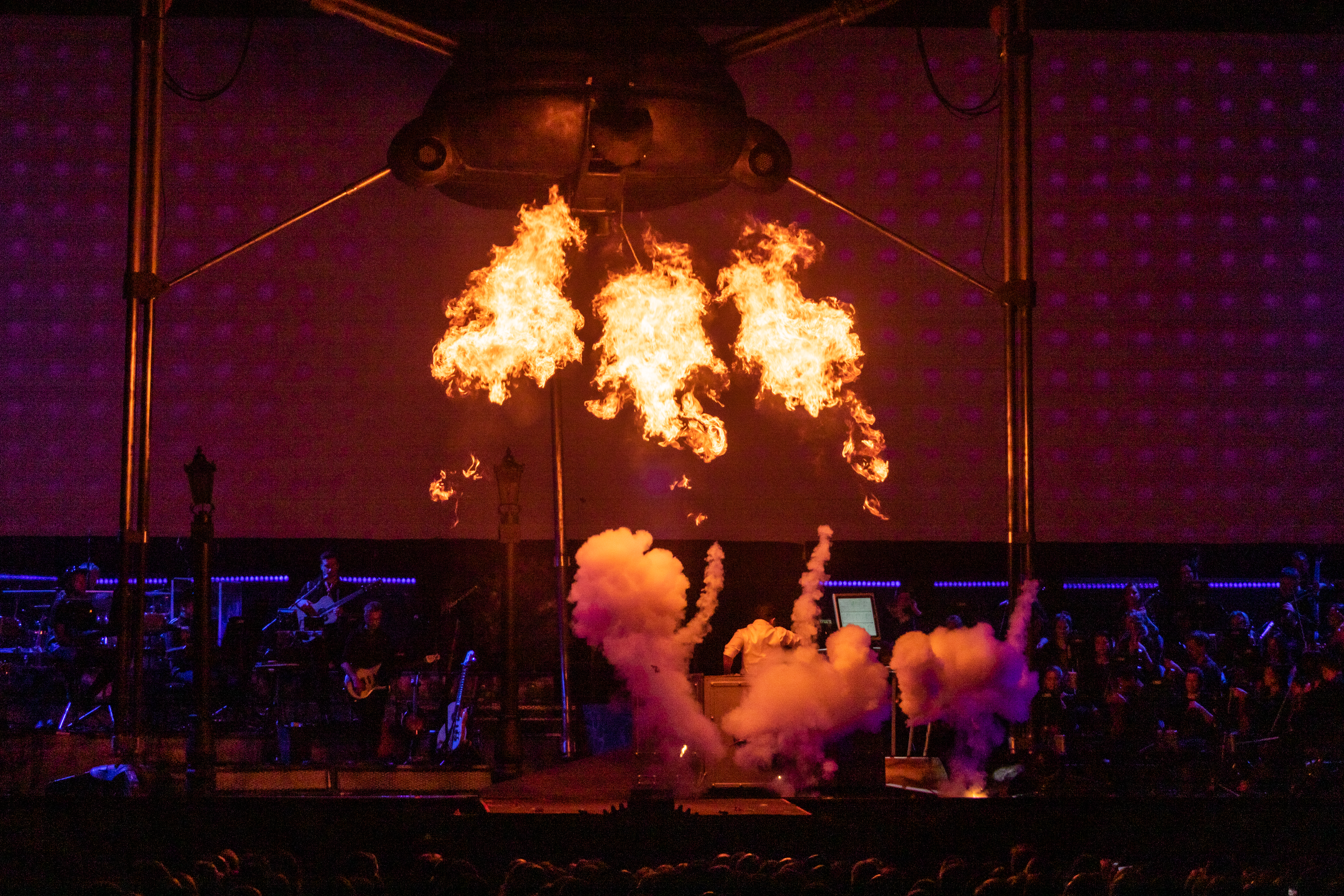
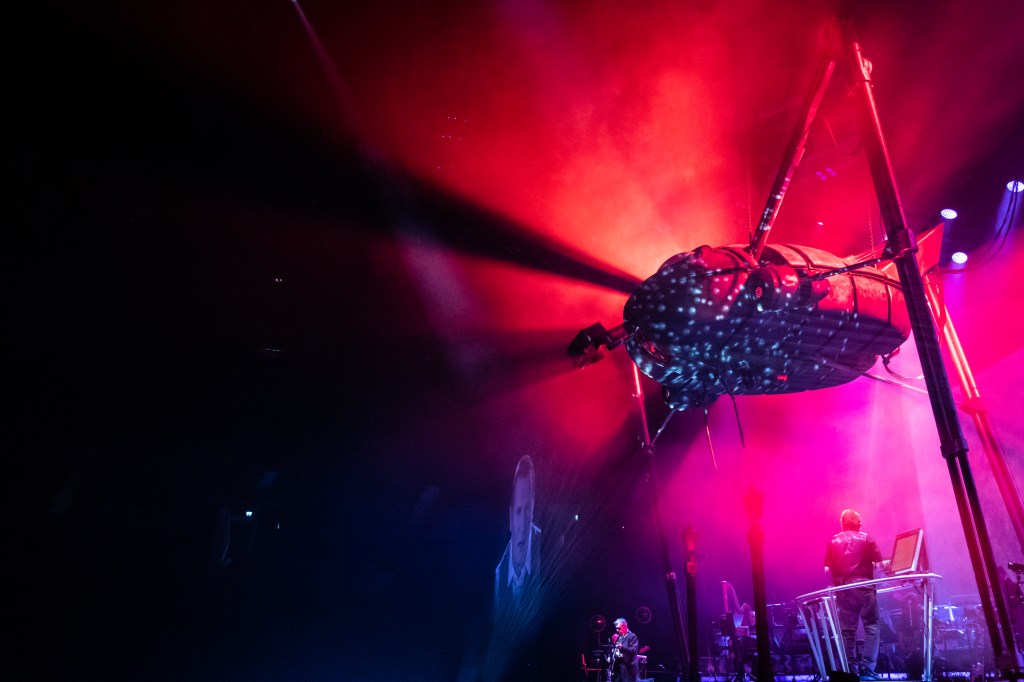
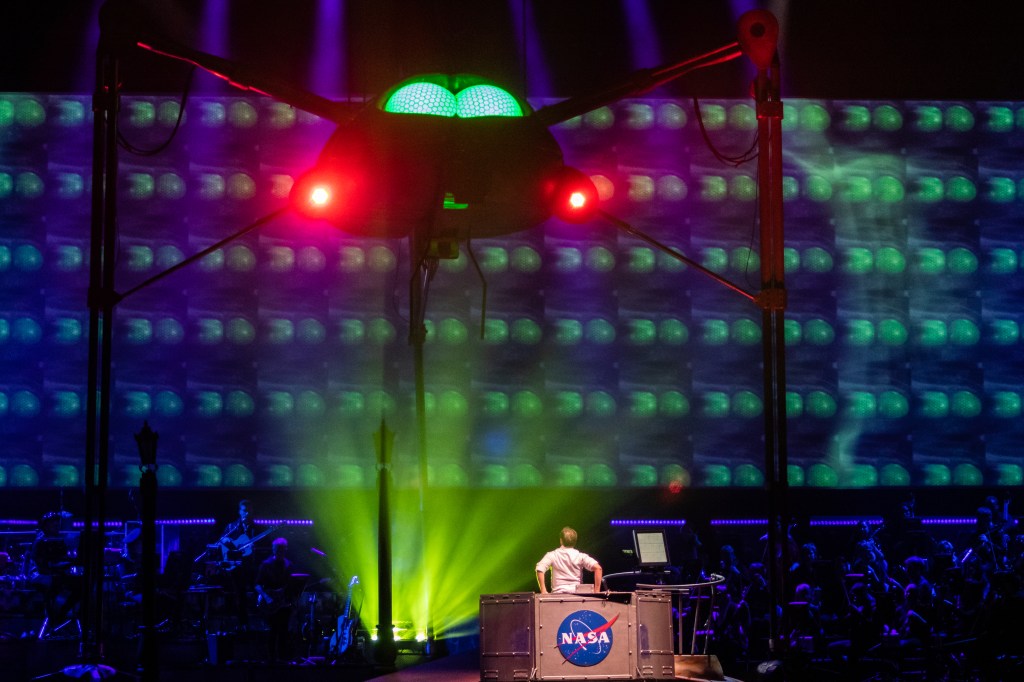
 As it turned out the scale of the set was just right for The Hydro. The measure of this was when the Martian Fighting Machine descended upon the stage, unleashing fiery blasts, the heat from which could be felt across the entire stalls and beyond. I have to be completely honest; my jaw hit the floor when I saw that thing coming down! My heart rate was already elevated from the tension of the story; the unscrewing of the first cylinder, the panic at the use of the heat ray; seeing a life-sized alien craft standing right before my eyes was quite extraordinary. I may have lost my breath for just a moment.

The accompanying sound too, was beyond my imagining. I could physically feel the landing of each cylinder, every explosion, and the Thunder Child certainly lived up to its name. The bone-melting cry from the Martians was enough to induce prog-rock sci-fi nightmares for at least another 4 decades to come. Musically I couldn’t fault the performance and the engineers really controlled the sound well. Original session guitarist, Chris Spedding, and bassist, Herbie Flowers, delivered their iconic parts with incredible vitality and effortlessness. I can imagine some fans of the original recording might be put out by the addition of new music (Life Begins Again was introduced in the 2014 production) but I’d like to think fans of this musical style, and the way the story develops through the music, can appreciate Jeff Wayne’s desire to grow his work and legacy through the evolution of the live performance.

As the show went on I became increasingly conscious of the wonderfully effective synchronicity between light and sound; not just in the obvious and violent moments, as in the flashes of destruction and battle, but through the more passive sequences too. The heavy stillness on stage as the alien red weed covered the landscape was so subtle but so crucial to the changing atmosphere at the beginning of the second act. The darkness over the band during the Forever Autumn Reprise duet created a magical moment between just The Journalist, the endeared narrator, and his distant fiancée.

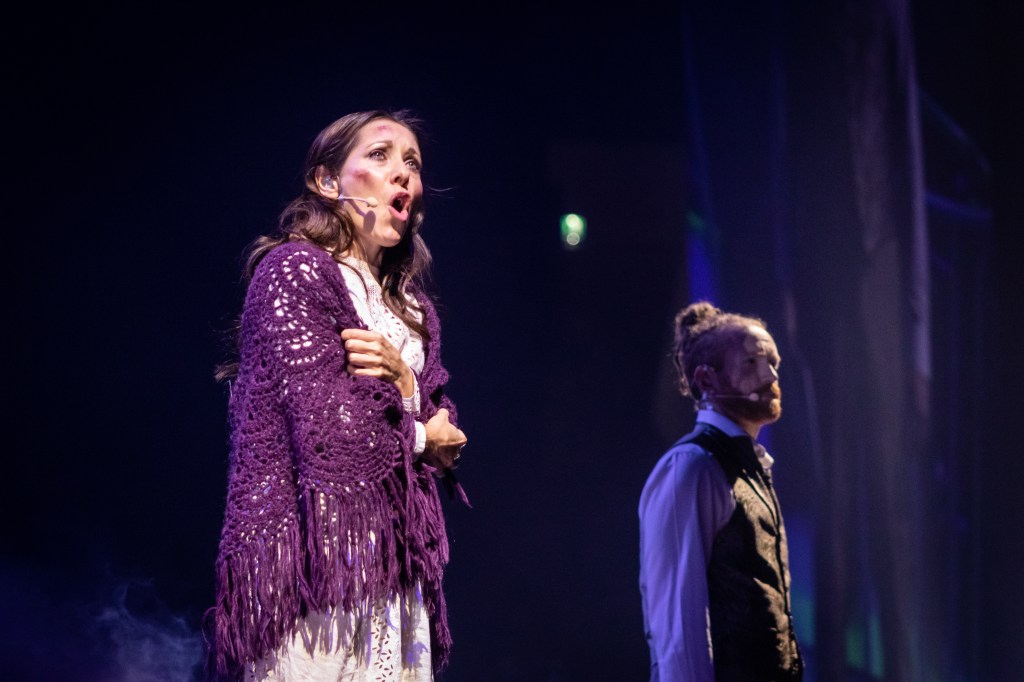
Having said I didn’t know what to expect going in, I was familiar with many of the performers, and I was still really impressed. Jason Donovan portrayed the grotesque anger and distressing confusion of Parson Nathaniel to the point of apparent fatigue. I was exhausted by the end of his frantic ravings. Playing opposite the delightful airiness of Carrie Hope Fletcher really emphasised the conflicted rage of his character; the two were dynamically juxtaposed brilliantly.

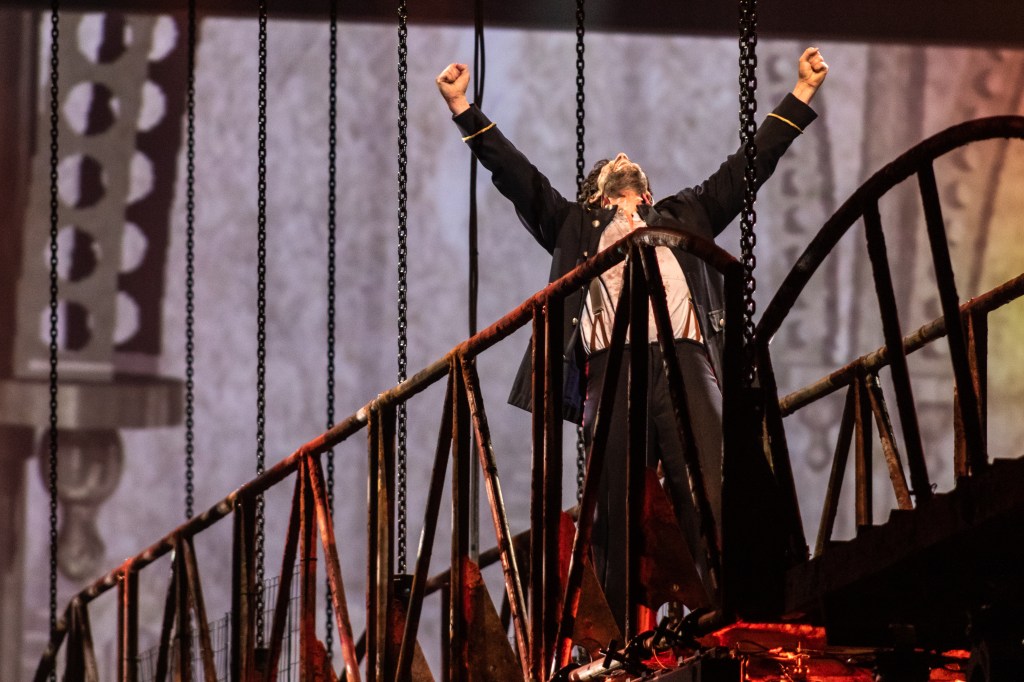
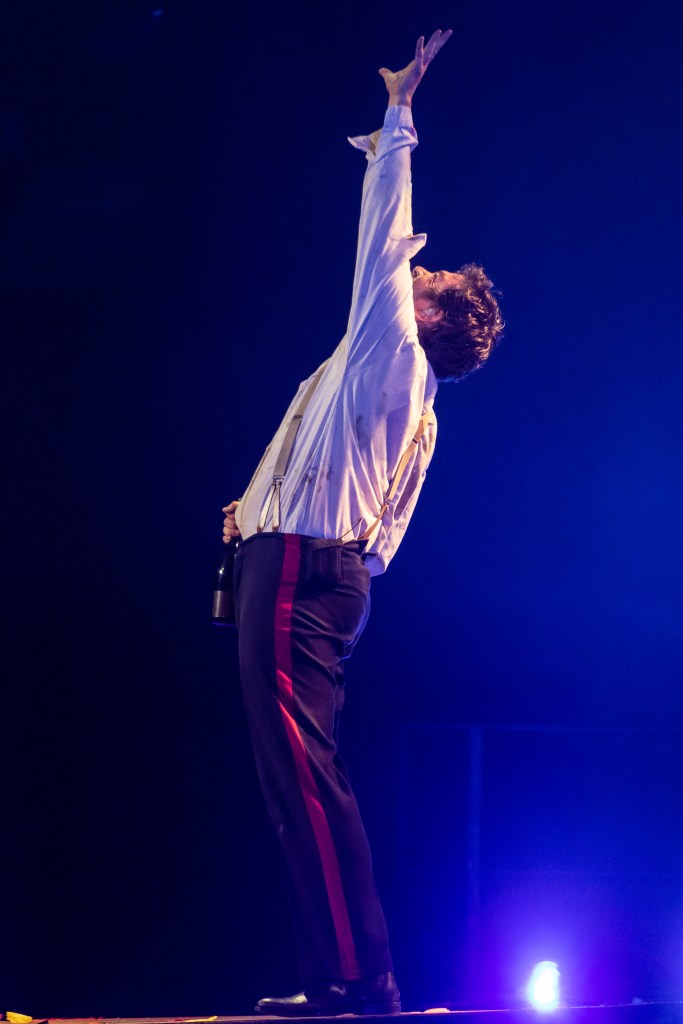
I found Adam Garcia as The Artilleryman a little bewildering at first, not that he didn’t embody the shell of a man gone to war with aliens, but that he didn’t in any way sound English at the first encounter. It wasn’t a major drawback because he really nailed it when he returned in the second act. His high note phrase – “We’ll start all over again!” – was perfect every time. Absolutely smashed it! His physicality was admirable too; he really worked to make his contribution immersive for the audience. Running through the crowd at first, and later summoning and scaling a bridge across the stalls added so much human energy to the overall performance.

The story shifts pace up and down throughout but the final resolution still feels hastily simplistic. The spectacular demise of NASA in the epilogue does well to offset this by concluding with a rather deliberately darker message than the narrator himself delivered. After all that had gone on I felt uneasy.

Later as I was leaving I overheard a woman telling a friend how her Dad had banned her from listening to the album when she was young. Apparently she played it all the time and it gave her nightmares. I would love to have been so defiantly brave as a kid! Her friend admitted “It still scares me” and the woman replied, “Me too; I won’t sleep tonight”. I slept alright actually.

Shakey Graves – SWG3 TV Studio

Live music, Music Review

It’s been more than a minute since Shakey Graves played to an audience in Glasgow. The artist from Austin, Texas was scheduled to appear at The Art School back in March of this year but the so-called “Beast From The East” snowstorm brought an early end to his tour and Scottish fans were left bereft for the time being as the show was cancelled, rather than postponed. Gratefully, another tour was announced for the Autumn but in the wake of the Glasgow School of Art Mackintosh Building fire an alternative venue was chosen and ultimately the gig took place in SWG3’s TV Studio – the very same room Shakey Graves last played in Glasgow over two and a half years ago.

Shakey Graves is the nom de plume of Alejandro Rose-Garcia, whose reputation precedes him through a kind of cultish following. He’s far from the mainstream as far as UK music press is concerned, yet he can find a devoted audience on just about every continent. This latest tour is in support of his new record Can’t Wake Up, released in May on Dualtone and, as anyone familiar this artist will attest, it’s a vastly different sound he’s touting these days.  Gone are the crunchy blues guitar riffs, raw-worn vocals and erratic one-man-band percussion. In their place is an overall more polished, controlled production; the lilting melodies and jaunty accompaniment have a kind of soft-focus and even Rose-Garcia’s voice is pastel-toned. Lyrically the songs are as mythical and mystical as anything in the alt-folk /Americana / country blues / southern rock canon, but with an added dreaminess that elevates them from being intensely personal to universally quizzical.

How then to marry these diverse sonic themes into a cohesive live set? Well, if anyone can do it and do it convincingly, it’s Shakey Graves. A stunning support set from Pennsylvanian artist Petal precedes the main event and is tragically disregarded by sections of the audience. Not even her exquisite cover of Fleetwood Mac’s Silver Springs could grasp the attention of many but it’s nothing personal; for reasons beyond comprehension the crowd are as distractedly chatty throughout the entire show.

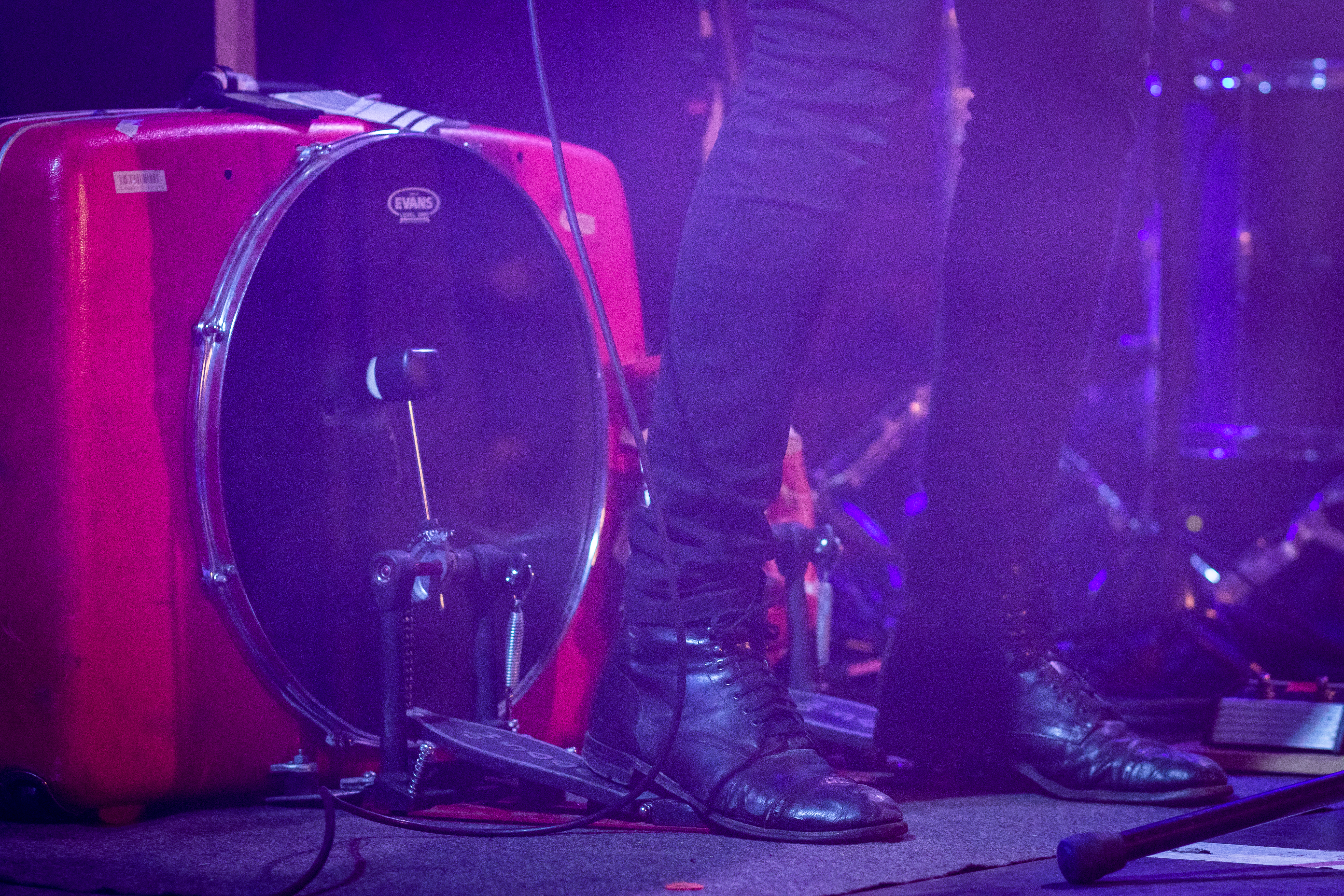
Arriving solo to the stage Rose-Garcia begins in familiar territory that sees the most vocal of his audience joining in. Armed with just an electric guitar and his suitcase kick drum and tambourine combo Roll The Bones glistens. The Perfect Parts swings into a pretty rendition of Pansy Waltz before he is joined by the other three members of his band. Christopher Boosahda on drums, Jon Shaw on bass and Patrick O’Connor on guitar complete the Shakey Graves touring line-up as well as being the core performers on the latest album. Immediately the more sophisticated beat behind Big Bad Wolf introduces the next chapter of the show gently. The mesmeric chirp of guitar on Mansion Door distracts from the darkness in its lyrics while the airy shuffling blues of Dining Alone lays its misery bare. The mood is never quite sullen and Rose-Garcia’s expression always tells more than each tale reveals.

Unknown Legend is the point where it really comes together, where the band and crowd are fully invested and committed to the groove; guitars are playing off one another, smiles are being exchanged and Rose-Garcia is especially talkative and comfortable in his banter. Excuses capitalises on this sweet moment with particularly dynamic playing – loud drums against soft vocals – matching the urgency of the lyrics “I can’t wait for summer, I can’t wait for spring / I can’t wait for someone who can’t wait for me”. It’s a natural climax at this point of the night and is followed up with yet another change of pace. Adequately sweaty for now, the band takes their leave to allow for a set of rootsier acoustic songs; Tomorrow, Family Tree and City In A Bottle prove to be definite crowd-pleasers with phones hoisted to film throughout, while the poignant Word of Mouth closes out the set in hushed awe. It’s a lengthy moral that ebbs and flows, drawing the crowd in until they’re hanging on every word. Shakey Graves is the complete entertainer at this point; he sticks his plectrum to his sweaty forehead for a time and dances on the spot. The crowd goes nuts. As the band returns and is officially introduced there’s a sense that the night is still just warming up but quickly then the realisation that we are, in fact, nearing the end settles and the crowd becomes restless and shouty once more.

A boisterous and out of tune singalong ensues on Dearly Departed which, from the band, seems to lack effort in the face of such an energetic reception. Rose-Garcia acknowledges the strict curfew saying “I’m not even going to fake going off” as he ventures one final morbid tale; Late July. The ending hits hard and he blows a kiss from the stage before waving farewell to his adoring fans. With such an extensive back catalogue to choose from, sixteen songs is never going to feel like enough for the cult of Shakey, but they take what they can get and show their fervent appreciation. It’s not so hard to settle for quality over quantity and there’s no disputing; this was a quality performance.

The Decemberists – O2 Academy Glasgow

Live music, Music Review

It’s an unexceptional Monday night in November that sees an audience gathered in the expansive darkness of Glasgow’s O2 Academy. It happens to be Bonfire Night which seems as good an excuse as any to stand around and listen to folk songs, and for this occasion you’d be hard-pressed to find a more literary story-teller than The Decemberists’ Colin Meloy. The communal spirit that his band embodies is alight in their followers too, and from the moment the band walk on stage there’s a warmth in the air. Fans haven’t just come to bear witness, they’ve come to take part.

A joyful opening set by Philadelphia’s Hop Along is encouraged despite the contrasting weight and density of the two band’s sounds. The overall energy is well matched and there can be no doubt the responsibility of the “warm up act” has been fulfilled.

With his harmonica poised Meloy gives a gracious welcoming salute as the rest of The Decemberists take up their positions.  Don’t Carry It All draws directly on the crowds in-it-together attitude with some vibrant singing and clapping along right from the outset. It’s apparent  early on that fans are elated to see the band again, as song after song is received in similarly boisterous fashion. The first half of the set builds momentum with some catchy choruses and powerful imagery. Blending new songs with the older catalogue happens around some of the more angular melodies; Cutting Stone into Shankill Butchers and despite wheeling out these darker themes early on the feeling in the room remains upbeat.

The Decemberists have a delightful knack for masking miserable tales behind jaunty mandolin and accordion but they also present honestly dour folk, as on the plaintive The Engine Driver which features two 12-string guitars for added pathos. This turns the midset into a rather gloomy interlude and yet the crowd responds with ever growing enthusiasm. “How about a song about the end of the world then?” offers Meloy before launching gleefully into Calamity Song. It’s a considered about-face of sorts, giving a glimmer of hope for at least sonic redemption before plunging deep into the grand tragedy of The Crane Wife 1 & 2. This song has possibly the subtlest build of any folk rock song to feature a xylophone solo and is followed unnaturally and yet obviously by The Queen’s Rebuke / The Crossing from 2009’s exceptionally heavy “The Hazards of Love”. The whole mood turns on this number as the lighting becomes dark and red, the sound is distorted and there is even a guitar solo!

From this point the brilliant synth-driven Severed introduces a suite of songs from latest album “I’ll Be Your Girl”. We All Die Young includes a necessarily tutored call and response bit of audience participation as well as an inappropriately uplifting sax solo. The band are beyond reach now, so elevated in their jubilation and commitment to giving a great performance. The grimmest tales of seduction, drowning and vengeful murder inside the belly of whale spur them on and the audience acquiesces with equal fervour.

Outside it remains an unexceptional Monday night in November but those in the dark of the Academy know it to be otherwise.

Kacey Musgraves – Clyde Auditorium

Live music, Music Review

“Born in a hurry, always late / Haven’t been early since ’88.” Could a truer opening line have been delivered? 20 minutes after she was due on stage the silhouette of Kacey Musgraves emerged behind a glow of goldenous light. With her band already positioned, distinctly indistinctive in their matching pastel suits, she set her pace with Slow Burn, the first song on her latest album Golden Hour.

The new record is mellow and even by pop-country standards and so it follows that its live incarnation, the “Oh, What A World Tour”, should be equally refined and engaging. It’s another 2 such gentle songs, Wonder Woman and Butterflies, before Musgraves visits any older material and when she does it sounds refreshed and renewed to her current mood. Keep It To Yourself leads in with a Springsteen-esque guitar tone before the pedal steel takes control and steers it into blatant country territory. More bitter than sweet, Merry Go ‘Round elicits the first big singalong of the evening and it’s hard to feel the isolated heartbreak of the song in a room full of voices. High Time is another crowd favourite and sees Musgraves stepping out of glam-mode, relinquishing her powder blue stilettos in favour of bare feet, then later some fluffy blue slides. It’s Casual Kacey time, despite the sequinned trousers and rhinestone-laden denim jacket.

On any scale a Kacey Musgraves show is certain things; honest, personal, fun. You can sense this from the flow of the songs and the onstage banter. While the music is perfectly polished, as it needs to be with a six-piece band behind her, Kacey is not above engaging with her audience in a way that makes her special among Nashville’s starlets. She feels her way between the songs as if the stage is smaller, the crowd is closer. It’s an intimacy that’s hard to pin down but it’s very real. She created the same atmosphere nearly 8 months back when she headlined the final night of C2C – Country To Country just across the way at the much larger SSE Hydro. Unlike then however, tonight she only has to play for her audience, rather than swaying a festival crowd, and she does so with much credit to her band. After taking time to introduce everyone on stage, and thanking all her crew behind the scenes, she brings the band together out front for a light-hearted rendition of Family Is Family.

Velvet Elvis sees sections of the stalls up dancing which Musgraves encourages, “This is a better party like this”.  It’s a gentle momentum to maintain with songs like Happy & Sad and the sweetly melancholic Space Cowboy but the crowd carries it on, finally arriving at the upbeat empowerment anthem Follow Your Arrow. Leaving the crowd in a jubilant state, Musgraves and band make a swift exit and remain obscured for several minutes before returning to frenzied applause.

It’s a mixed bag encore opening with the achingly delicate Rainbow before detouring into a humorous but ultimately unnecessary cover of NSYNC’s Tearin’ Up My Heart. The only redeeming aspect of the cover is that it features the support act, the very talented indie singer-songwriter Sophie Allison, aka Soccer Mommy, in a choreographed dance routine. Nevertheless, the mood is lightened sufficiently to close the night out with brilliant rainbow strip lights and a dazzling mirror ball as High Horse wraps the night in its fuzzy disco charms. In the last twinkling light before the stage fades to black Kacey Musgraves waves a sincere farewell to her adoring audience and they respond with mutual gratitude; each wants to thank the other and no-one wants to say goodbye. It’s the way every show should end.

Lord Huron – The Sage

Live music, Music Review

“We’ve always been a ghost-friendly band” quips Ben Schneider. “It’s good to see they’re out tonight especially in the upper levels. They’re going fucking nuts up there by the way” he jokes while he demonstrates an exaggerated style of dad-dancing. It might be a surprise to UK fans of Lord Huron to find the band booked into such an extravagant venue as Sage One in the beautiful Gateshead complex but by the end of their spirited performance there could be no doubting, this is a band who belong on the big stages.

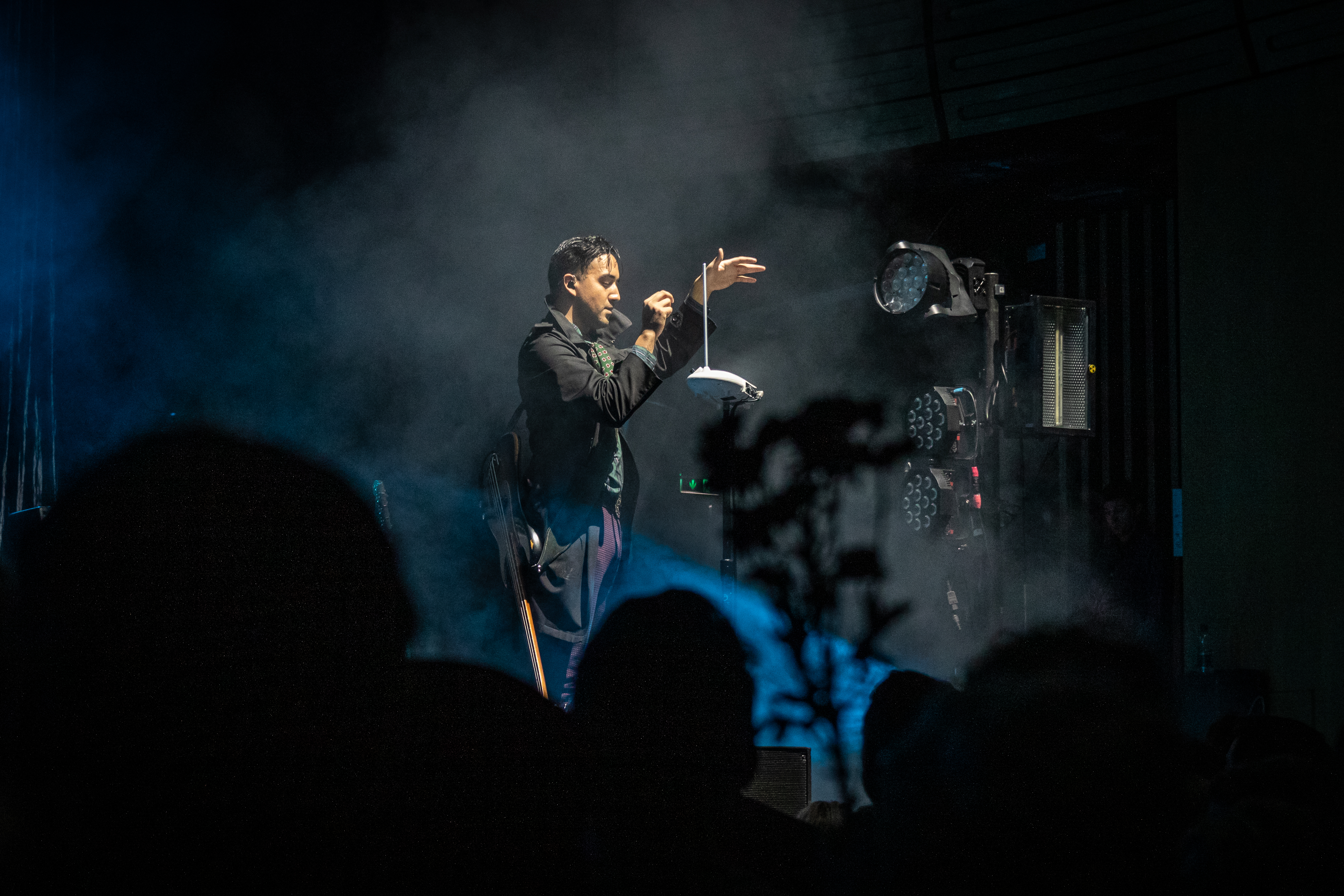
Other venues on this leg of the Vide Noir tour have been as varied as any the band has ever played; from a night at London’s famous Roundhouse to the obscure Sheffield nightclub, Plug the night before their appearance in the north-east. Schneider points out that they’ve never played on this side of the river before and it seems by the crowd’s response that they’ve also travelled from outside the local area. This is the second round of touring in the UK for Lord Huron this year and they’ve made certain to cover new territory once again, bypassing Manchester in favour of Liverpool, and leaving out Scotland, Ireland and Wales altogether. It’s perhaps unsurprising then to find rows of empty seats in such a grand concert hall, for a band who typically fly under the mainstream radar, however this void in no way diminishes the band’s performance. The energy radiating from the stage throughout their set is just enough to reach the souls at the very back of the hall without black-braining them in a cacophony of distorted guitars, storming bass, luscious harmonies, turbulent percussion and eerie theramin. All these sounds exist within the space but never is one found wandering aimlessly.

The set is heavy on tracks from the latest release, “Vide Noir”, which sees the band experimenting a bit more with the dark side of studio magic. There are times, before the band first emerges on stage and at occasional intervals throughout, where a mysterious voice urges listeners to “follow the emerald star” while a jazzy lounge tune grooves in the background. These mellow moments are offset by Schneider’s resonant vocals and Miguel Briseño’s pulsing bass. Opening with the buoyant but chorus-less teaser Never Ever, the band lay their intentions bare: We came to rock! The feeling is mutual, at least on the floor where punters are bouncing around, fists pounding the stratosphere in attempts to reach a heightened state of elation.

The World Ender is a dark and brooding tale that brings everyone crashing back to barren earth, unsure how they arrived and curious to see what fates await. Meet Me in the Woods continues their journey into the unknown before emerging through the black magic of Secret of Life and the character study of a chance meeting with an undead World Ender in Dead Man’s Hand. Schneider’s hair refuses to be contained beneath his fetching fedora and the hat meets the ground at regular intervals as the band lift off on more raucous songs like Back From The Edge and Ancient Names, Pts. 1 & 2. There are also times when Schneider removes his headwear for romantic effect as on the crooners Wait By The River and When The Night Is Over. There’s a sonic theme to these songs on the record that is well spaced in the live set, always keeping the crowd in anticipation of their next wayward turn.

The echo of an owl, a distant thunderstorm and crackling campfire lead into a string of crowd favourites from the band’s debut LP, 2012’s “Lonesome Dreams”. Ends of the Earth, Ghost on the Shore and She Lit A Fire instantly transport devoted listeners back the band’s earlier explorations while providing an atmospheric shift in the tone of the evening. It’s subtle but cleverly crafted. Moonbeam and Hurricane stir up the crowd with additional guitarist Brandon Walters and keyboardist Misty Boyce having their own dance-off either side of drummer Mark Barry. It’s a fun set and the audience can’t help but catch the vibe too.

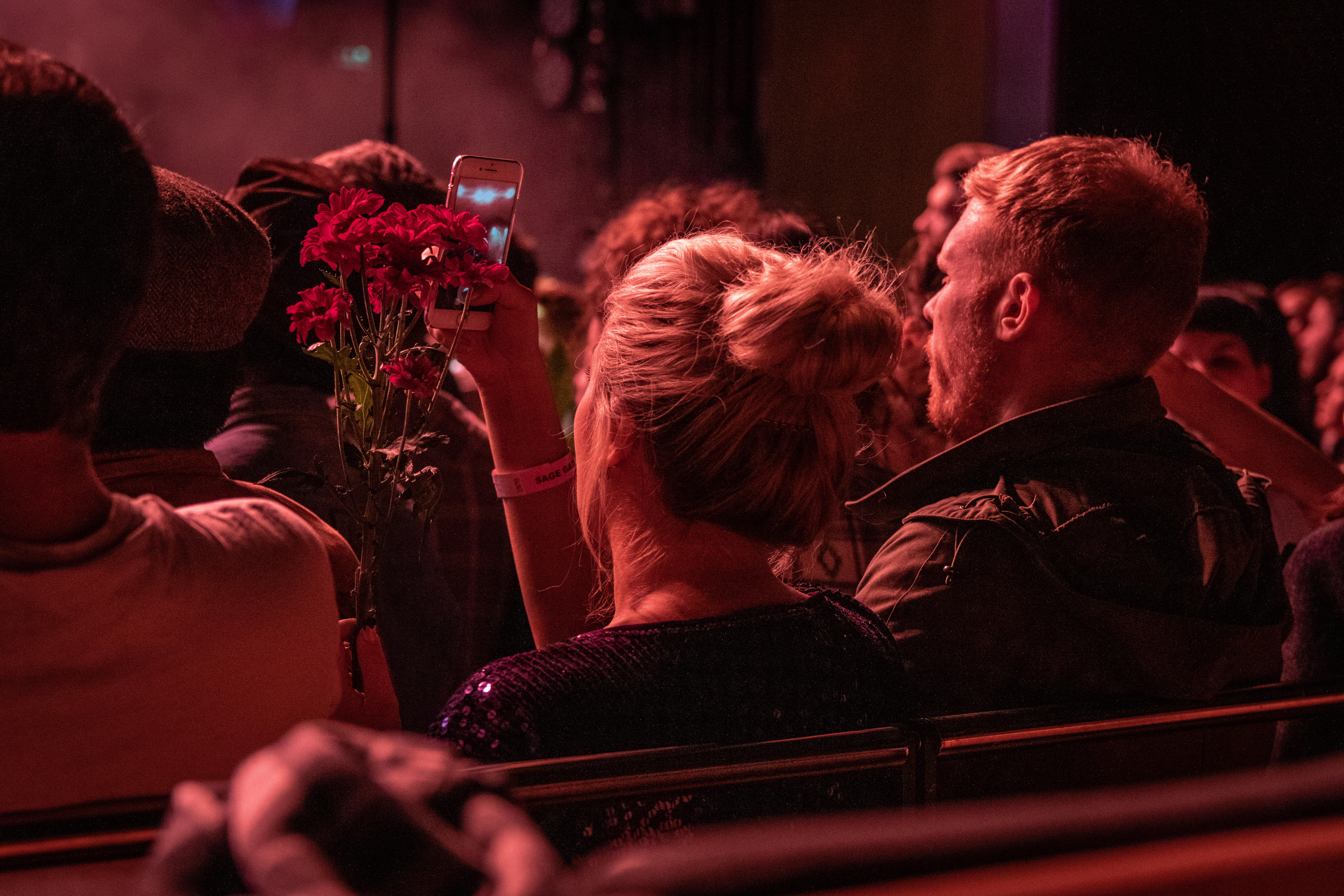
Between the pulsating green lights that silhouette the band on the Ancient Names twin-set there’s a romantic interlude from “Strange Trails” in the form of La Belle Fleur Sauvage and Fool For Love which sees Schneider throwing flowers into the audience before accepting certain death in a bar fight over the object of his affection. It’s the kind of dramatic contrast fans have come to expect from the last two albums and it’s well received by the audience, by now hustling to keep up with the twists and turns of the night. Way Out There takes them gently by the heart and leads them through the dark spectral landscape. The set winds into its natural close with Time to Run. The energetic acoustic anthem is embellished with flourishes of Tom Renaud’s gloriously crystalline guitar, playing out the main set before another haunting voiceover recites a poem composed explicitly for the Vide Noir shows featuring, among its lines, every song title from the album. It’s weird but it fills the void left by the band’s departure.

There’s no need for an awkward, forced encore – not that the crowd weren’t demanding one anyway – and when the band re-emerge from the darkened recesses at the edge of the stage they bring yet a new energy with immortal hit The Night We Met. The song has been popularised by its use in various TV drama series but the core fans knew it as the bittersweet album closer to “Strange Trails” over 3 years ago. On this occasion there’s a hopeful sense that Lord Huron will return to UK theatres of this scale in the not too distant future, to wow new audiences with their unique stories, curious characters and vivid soundscapes. Nothing could exemplify this more than the jubilant finale, The Stranger. Delighting their audience with arguably their most successful single and following it up with one of their least known tracks is the kind of stunt a band like Lord Huron can pull off in any setting, such is their devoted listenership and the inspiring diversity of their catalogue.

Rumours of another turn through Europe next year have left fans hanging on the edge of the known realm, aching to see what mysterious encounters lay beyond.

Villagers – The Garage

Live music, Music Review

On Villagers’ most recent album The Art of Pretending to Swim Conor O’Brien has got his groove back, and then some. The nifty studio magic that gained his band a raft of followers through their first two releases has been distilled by a master craftsman, O’Brien himself, and blended with the raw potency of 2015’s Ivor Novello-winning Darling Arithmetic. The result is a heady concoction; harmonically vibrant and playful with subtly textured rhythms, and laced with O’Brien’s always intriguing lyricism. It tempers listeners with bold satire and heartfelt musings on where we place our faith – in love, humanity, religion, ourselves – all served over luscious layers of acoustic guitar, piano, strings, brass and occasionally low-key EDM.

Bringing an album of this sonic complexity into a live setting presents those same old challenges from the earlier recordings but O’Brien has assembled a fine musical collective to support his endeavour, most of whom toured Darling Arithmetic and later crafted the live recording Where Have You Been All My Life. He also has a breathtaking opener for this run of shows in Billie Marten, whose heart-on-sleeve songwriting and bare-bones delivery softens and diffuses any pre-gig tension, melting anxiety whilst gently building anticipation for the main event. A kind of Julia Jacklin wit by way of Lucy Rose delivery. Poignant and ethereal. Also she brought cake – lemon drizzle – as a sort of apology for having not brought any merchandise “because I’m a terrible person”. She is not terrible; nor is her cake, nor her performance. All are quantifiably sweet.

Villagers’ arrival on stage is met with an almost stupefied enthusiasm, as if the crowd are unable to fully grasp their own excitement. It’s been over two and half years since the band last played in Scotland. A heightened sense of expectation is inevitable. Breaking through that energy, the band lay down four new songs to open the show; Sweet Saviour and Again wind the new sounds out slowly, growing through O’Brien’s impeccable finger-picking before blossoming with pulsing piano and swirling synth. The jovial, swinging melody of Fool defies its bleak message and sees the audience bopping along unassumingly, while the Moby-esque Love Came With All That It Brings recounts a tragic tale over a hip-hop backing track, held aloft by flugelhorn and cornet. It also features the gentlest delivery of “motherf**ker” you could ever imagine as O’Brien’s lips conjure all the venom that melody will allow (consider Beck’s Asshole but more tender).

A concerted look between O’Brien and pianist Mali Llywelyn cues the flourish that begins I Saw The Dead and rouses the crowd further – they could hardly be more excited about hearing an old favourite. Another four songs from the new album follow; Hold Me Down, more or less the only quiet moment of the set, draws breath and displays a calmness within the band. There’s joy and playfulness apparent in their performance, but also control, restraint, focus. The weight of expression in O’Brien’s voice is offset by the intuitive spontaneity of the musicians around him. This only becomes more enlightened as the set continues; the R&B-infused lead single A Trick of the Light matches O’Brien’s distinctive annunciation with Danny Snow’s emphatically funky bass line.

“This is a groovy number; your hips better be shaking. It’s about procrastination.” O’Brien introduces one of his most soulful compositions to date, Long Time Waiting. He’s not lying, it definitely has a feel-good vibe, uplifting yet meditative, and catchy as all get-out. The song builds gradually with an irrepressible, boisterous vitality, flowing naturally into the thumping Real Go-Getter. Marcus Hamblett’s jubilant smirk throughout is indicative of the fun had in crafting these songs, as much as in delivering them with sonic precision. His role at this particular moment comprises two critical sounds that shape the whole tone of the song and he’s taking it very seriously…whilst smiling.

The back end of the set sees a few “hits” pulled from the catalogue; the iconic Becoming A Jackal is still one of the most interesting pop songs to emerge in the last decade and here it assumes a jazzier identity thanks to Gwion Llewelyn’s creative drumming that leads instinctively into the moody, stirring Memoir. Perhaps it moves a little too swiftly as O’Brien loses his words after the first verse and calls the band to stop. Running lyrics between the audience and the band over the longest 20 seconds he resumes, then forgets again on the next verse but improvises. This only lightens the atmosphere further with a splash of endearing humility and O’Brien confidently progresses to the end with the captivating Hot Scary Summer and album closer, an epic ode to the work of Ada Lovelace, simply titled Ada. The latter swells, spirals and cascades well over the five-minute mark and leaves the crowd hanging on to the final note before erupting with applause and cries for more.

A brief absence from the stage punctuates the set before a swift encore caps the night off with the crowd singing in unison. Intimate anthem Courage sounds authentically country in this setting with O’Brien’s delicate strumming so precise you can hear every string resonate beneath the exquisite range of his dreamy vocal, now at peak mellifluence. Squeals of relief and delight meet the opening of dichotomous favourite Nothing Arrived as the band deliver a buoyant rendition, charming yet raucous, and always bittersweet. It’s a fitting close to the night, where all is not but exactly what it seems. Conor O’Brien has never looked so resolutely content and confident on stage as he does right now, and while showcasing these new songs, with this band, he very much deserves to.

John Butler Trio – Barrowland Ballroom

Live music, Music Review

John Butler Trio’s latest album Home is an introspective detour on the Australian songwriter’s journey. While many artists start off their careers drawing on their internal struggles and gradually looking outwards John Butler, whilst being outspoken on public matters of social, political and environmental significance, has kept his innermost self quite private. The new album, released on September 28th, touches on subjects close to the songwriter’s heart including the joyous miracle of finding his soulmate in the middle of nowhere, as well as his developing battle with anxiety. Sonically and thematically it’s a substantial step away from his previous work, showcasing a more polished pop aesthetic with synths, drum machines and especially charming melodies. Some critics may have been disappointed but it is undeniably refreshing to hear a new development in any artist’s catalogue, particularly one with as many influences as John Butler has synthesised in the last 20-odd years of his career.

Within two weeks of the album’s release the band opened their European tour at Glasgow’s Barrowlands. Fellow Australian-Samoan singer, songwriter and multi-instrumentalist Bobby Alu set the show up beautifully in support, with his laidback ukulele tunes and warm, soulful voice. He was well received by the early crowd who seemed to grow in size, evermore endeared to the gentle sway of his songs whether in English or Samoan, there was a very natural enjoyment to his being on stage with some people even calling for more when he took his leave.

It seems ominous then that when John Butler reached the stage he was nervous, however the crowd were elated and generous in response and the music flowed easily. Jaunty Tahitian Blue and the heavier Wade In The Water introduced the new material before Butler let slide on Betterman. “I don’t know why I’m so nervous tonight” he declared as he positioned his banjo before flawlessly fingerpicking his way into Better Than. Perhaps debuting so many new songs in one live session had him on edge but it hardly showed, only his minimal conversation suggested he had things on his mind. Eight out of the eighteen songs on the setlist came from Home but there were plenty of crowd-pleasers in the mix too. The earthy, slow blues jam Blame It On Me had the crowd so mesmerised that by the time the solo had wrapped up and every possible kind of effect had been wrung from the guitar, there was a delayed eruption of applause. Pickapart brought the audience out of their daze and saw limbs flying as bodies failed to resist its funky bass line. A fifteen minute rendition of Ocean was delivered solo with as much tenderness and passion as an orchestra could summon; an epic guitar odyssey in open C, filling the night with the simplest of dazzling green lights. It’s the highlight of any John Butler performance. Expanded to a five-piece for this tour (billed as John Butler TRIO+) the band switched instruments regularly and made good use of the extra hands particularly on the title track Home which featured four of the five drumming in unison over dark synth and bass. Funky Tonight left the crowd begging for more and the band obliged with a two song encore; between the resonant, swirling acoustic guitar and communal drumming circle, latest album closer We Want More displayed its tribal colours, before Butler invited the crowd to sing their hearts out with him on the rootsy hit Zebra. “It doesn’t have to be pretty, it just has to be loud” he encouraged. That it certainly was, albeit in a very relaxed, casual and organic kind of way. You wouldn’t expect more from a John Butler Trio audience really, just an abundance of peace and love, and that was exactly how the night ended.