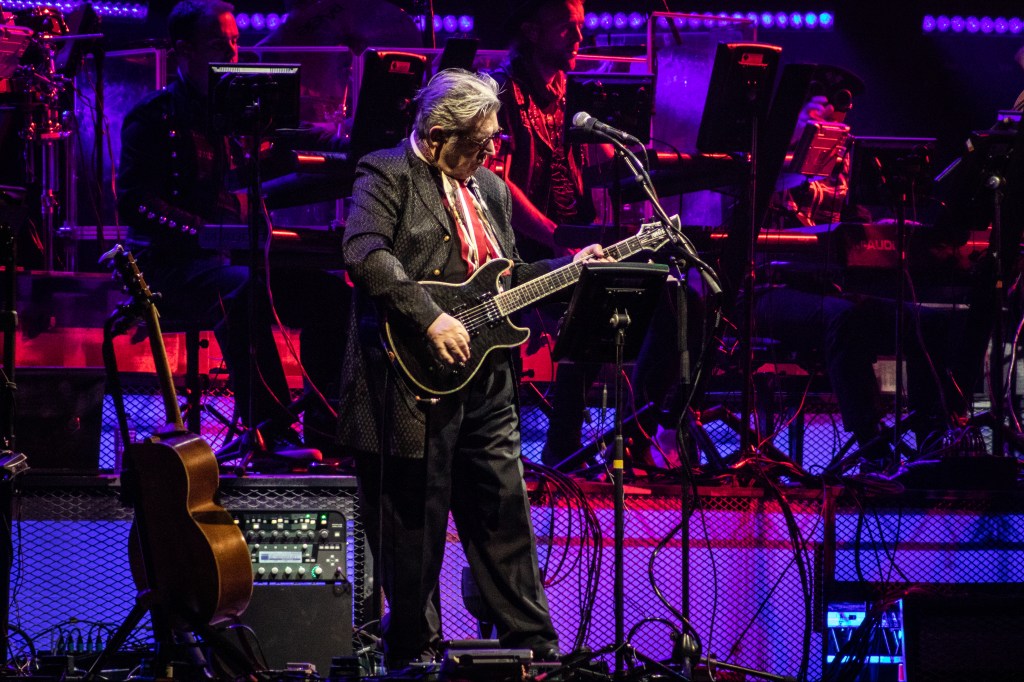
Jamie T – O2 Academy Glasgow

Live music, Music Review

Jamie T is back in the game!

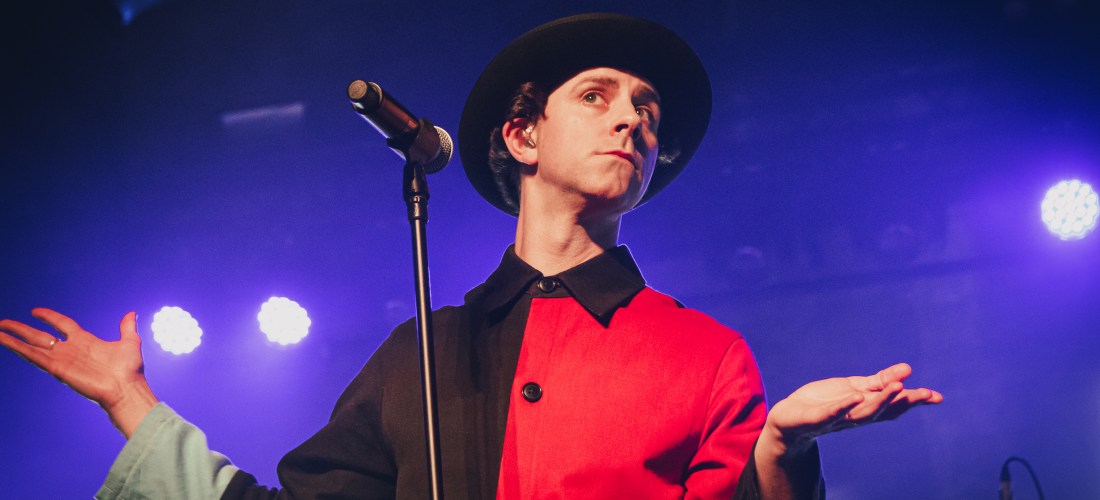
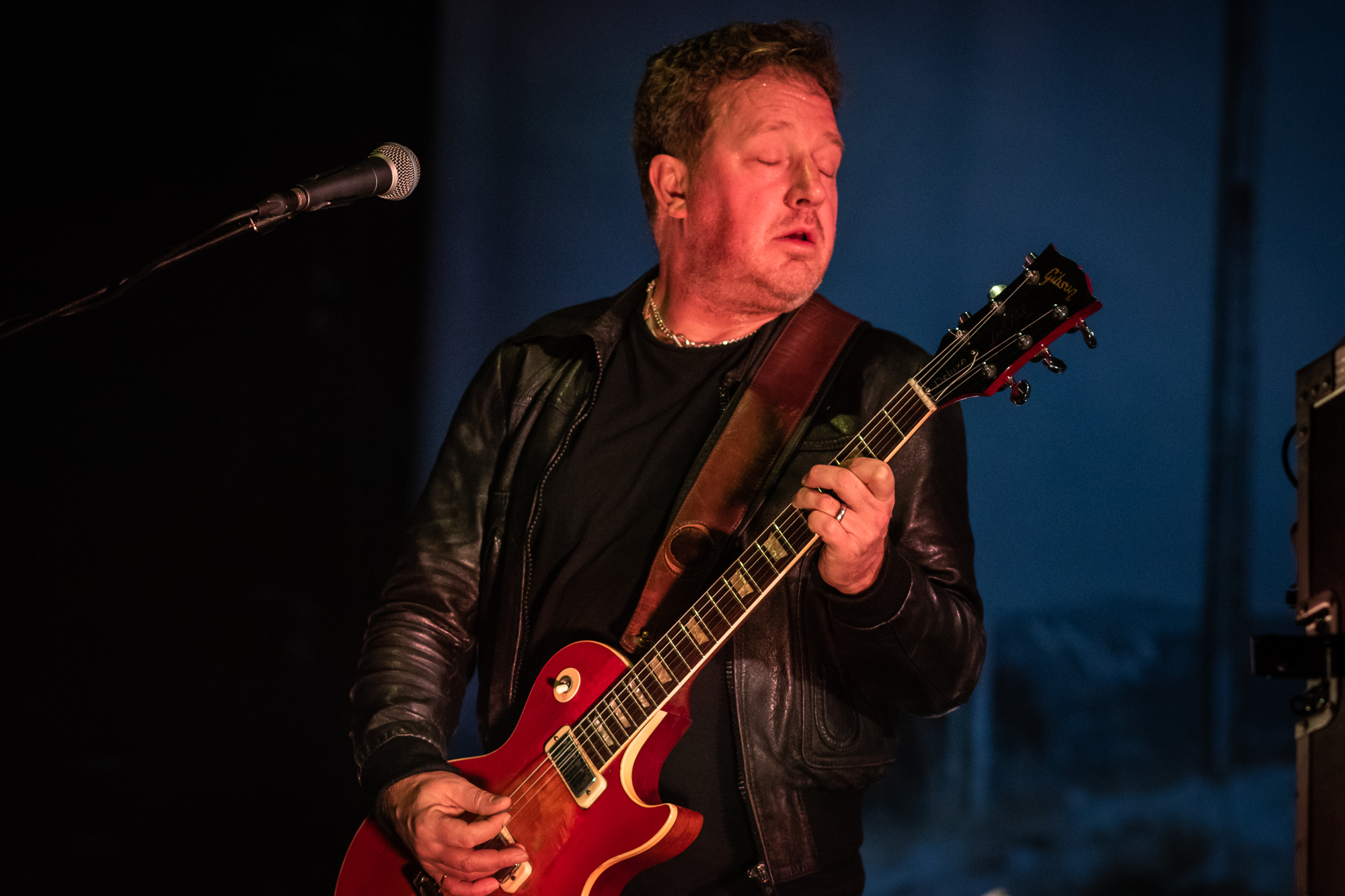
The indie punk poet kicked off his first headline tour in five years at Glasgow’s O2 Academy – the first of two sold out shows at this venue. Where it’s typical for big acts to schedule gaps in their tours for adding extra shows once the original dates sell out, Jamie T (real name Jamie Treays) is bookending his now-11-date run somewhat unconventionally with second visits to Glasgow and Manchester respectively. Read into it what you like but the singer-songwriter’s unwavering popularity in university towns, particularly across the north, is undeniable.

What’s also apparent from the excitable crowd in Glasgow is that Jamie T inspires the kind of obsessive loyalty in fans that’s usually reserved for rock legends and pop music’s elite. These are a different breed of devotee who can withstand years of relative silence, an absence of musical output, and minimal social media interaction and still be ready to swarm on any opportunity to see their man perform. Fans have travelled from all across the UK and some even made the trip from Europe to be at the opening night of The Theory of Whatever Tour. If Jamie T has casual fans they likely missed out on tickets; this show is packed with only die-hards!

Those who arrive before 8pm – a good majority – are treated to the first official public performance by new outfit 86TVs. The band sound like all the best elements of your parents’ record collection with mind-altering melodic hooks and irresistible vocal harmonies, crisp, steady drums and groovy bass lines, all delivered with an unassuming air of confidence. It’s the kind of performance to convince naive audiences that great songs come easily and genius is the default of true creatives. The fact that 86TVs comprises four veterans of the indie rock scene maybe goes some way to dispelling this myth but it doesn’t detract from the exceptional quality of their opening set. That they only play for 28 minutes is a real disappointment.

There’s no false bravado when Jamie T takes to the stage; the artist possesses a genuine and earned swagger. In the 15 years since the release of his debut album, Panic Prevention, Treays has established a unique status within the UK music scene through his authentic vulnerability, disarming wit and unashamedly astute lyricism. Largely evading the burden of hype and expectation, he has committed diligently to his craft and consistently delivered savvy, incisive, relevant and fun songs that defy the boundaries of any one genre. His fifth LP, for which the tour is named, is a collection as clever as it is charming.

The Glasgow crowd is a mix of ages – young couples brace and embrace along the barrier beside an adolescent boy and his guardian, and on the other side an older gentleman raises his walking stick with vigour. The set opens with 90s Cars and The Old Style Raiders, as per the latest album, and the audience responds like they’re old favourites. Jamie T has always been something of a sonic shape-shifter, and comfortably anachronistic, so it’s curious and exciting that right now he sounds the closest to indie that he ever has.

Acknowledging that he hasn’t played out in a while, Treays intends to deliver a set that covers all eras of his career, with something for everyone. And he does. There are highlights upon highlights; to borrow a phrase, it’s all thriller no filler. The ukulele foundation of Spider’s Web underscores one of many joyful singalongs and sees friends boosting friends on shoulders; the opening chord of Salvador chimes like a call to attention and is met with a plaintive chorus of voices near enough to wake the dead. A Million & One New Ways To Die is another song that embodies the “new fave” with its oddly familiar guitar motif and anthemic pseudo-emo chorus. Solo ballad St. George Wharf Tower is a bold but beautiful move in front of a restless crowd and he follows it up with Back In The Game – just a man and his acoustic bass guitar – showcasing the accomplished intricacy and vibrancy of his songwriting, as it was and continues to be.

Pint cups are launched towards the Academy’s central dome as The Man’s Machine and 368 bring the show towards a ferocious climax, yet both audience and band remain equally buoyant, in synchronised ecstasy. Chants of “Jamie-fucking-T” bring about a three-song encore during which the audience, facing in all directions, bounce, swell and radiate jubilation en masse. At the end the atmosphere is simultaneously chaotic and focused, pure, ragged, and elated; an honest reflection on the music of an artist still finding his edge and an audience willing to follow him there.

Maggie Rogers – O2 Academy Glasgow

Live music, Music Review

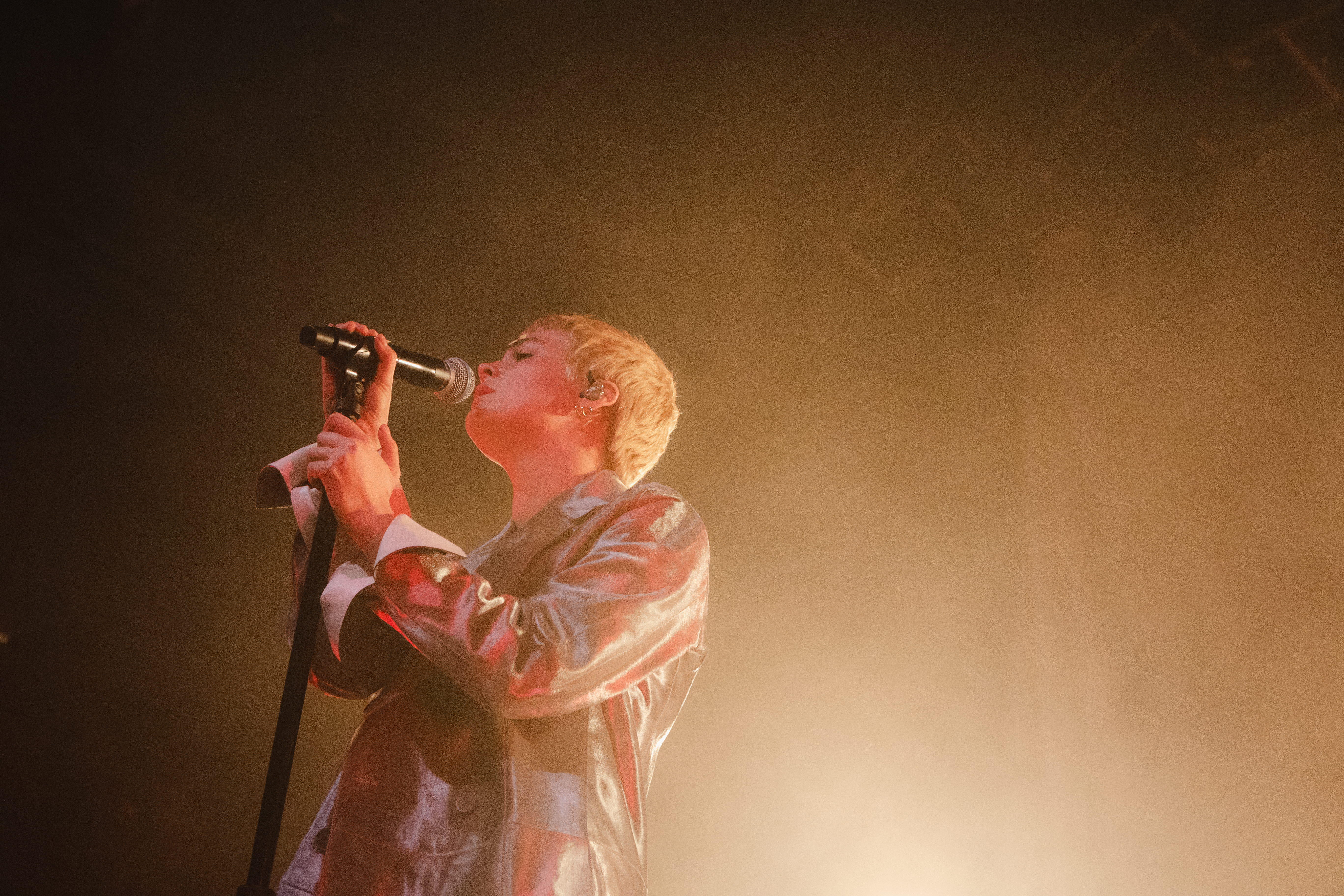
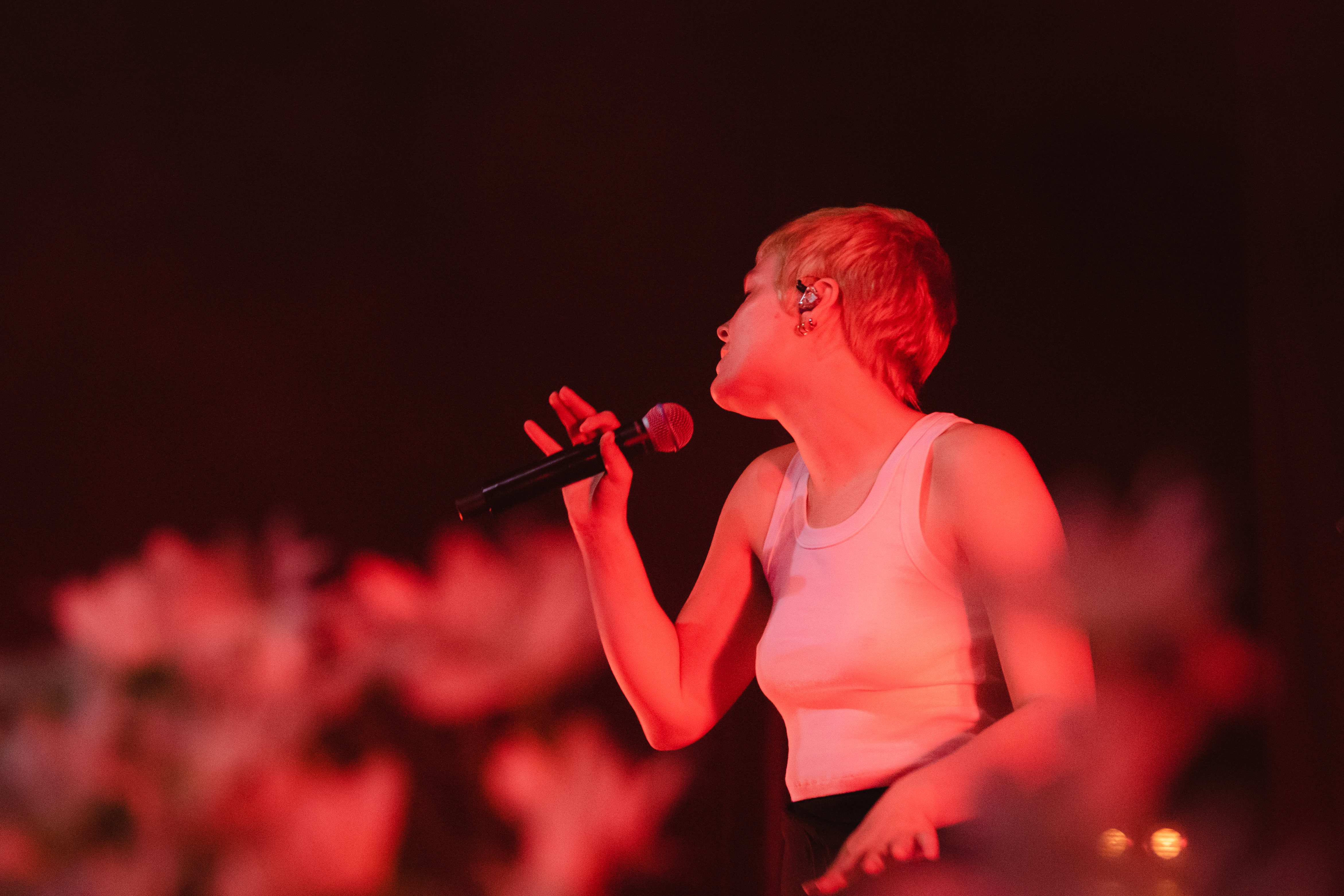
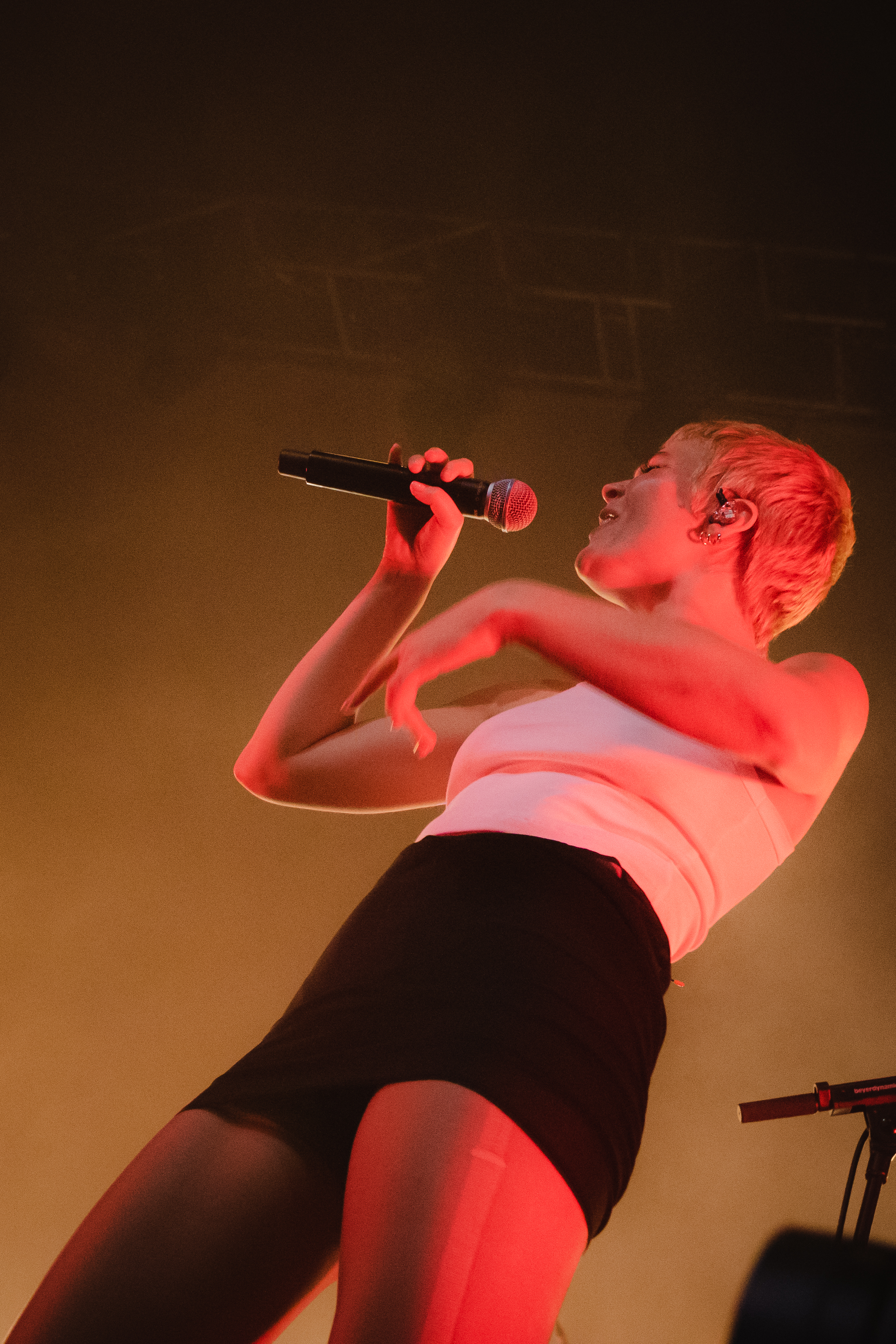
November this year begins, as we’ve come to expect, mild and rainy. It’s an otherwise innocuous Tuesday, perfect for doing nothing after a weekend – and Monday – revelling in our first proper Halloween celebrations for three years. Maggie Rogers has other plans though; she wants us to be together, to dance and sing and scream, and who are we to refuse such an invitation?

Our evening commences with a sweet serenading by Samia, whose charm exists somewhere between her lofty vocals, a cute ra-ra skirt and cowboy-boot combo, and the dance school finesse of her stage presence. She’s radiant as she introduces her songs, vignettes of youthful innocence and disillusionment, romantic fantasy and the banality of everyday life, each received with generous screams of recognition. With two songs left she asks, “Can you come on the rest of the tour? I feel like we’ve really…connected.” I feel like we have too, in pursuit of escapism.

That’s what this night is all about: Feeling connected. Rogers said via social media that her aim for each night of this tour is to deliver a set which “starts with some heat, leaves the middle for an emotional release, and still brings us all together at the end.” This is precisely what ensues.

Latest album Surrender is played out in its near-entirety over the course of the night, giving ample opportunities for catharsis both on the stage and within the audience. Want Want is explosive. Alaska and Love You For A Long Time elicit exuberant singalongs. Shatter leaves everyone desperately breathless. Silhouetted like a phantom at the back of the stage, Rogers exorcises some deep frustration on Honey before composing herself within the quiet solace of The Blue Nile’s Let’s Go Out Tonight. It’s a perfect turning point, a place to rebuild from. In the live context Symphony has an air of Fleetwood Mac about it, emphasised towards the end as Rogers dances and spirals in perfect synchronicity with the band’s tight ritard.

“I missed this,” she declares simply. Like a close friend, a sense of identity, a vital organ? One can only imagine what “missing this” for the last three years has felt like for an artist with so much emotional investment in their live exchange. Back In My Body presents as a kind of reconciliation with that touring life. It’s not always glamorous but it has a purpose that Rogers, now even academically, understands. Between the powerful percussion that closes Begging For Rain and the raw vocal and acoustic guitar on Horses, Rogers mines a deep seam of emotion to wrap up the set. Even before the climax, following Anywhere With You, the crowd erupts into such thunderous applause that it delays the big finale of Light On and That’s Where I Am. Rogers and her band stand in awe, gratitude glistening all over them. They drive the performance to its incendiary conclusion and return for an encore that feels both extravagant and essential. Surrender’s closing track Different Kind of World exists to mollify the end of this night together; a feeling and a memory to carry with us as we walk back out into our dreary reality. A connection. Thank you, Maggie.

A version of this review is published by The Modern Record

Maximo Park – Boiler Shop

Live music, Music Review

Maximo Park kicked off their first proper UK headline tour in four years with an exuberant sold-out hometown show at Newcastle’s Boiler Shop on Saturday night. Having been rescheduled from the early summer due to ongoing restrictions the show took place just two and half weeks since the band last performed in the city. On that occasion a small run of shows celebrating their 2007 sophomore album Our Earthly Pleasures was offered in gratitude and as an incentive to fans who bought their newest album Nature Always Wins which charted at number 2 in the UK upon its release back in February. A series of album release out-stores was also scheduled in late August with a couple of festival slots thrown in as well, so in actual fact the band should have been in the full swing of national touring by now.

A lot can change very quickly in these times however, as we’re all acutely aware, and in the intervening period singer Paul Smith contracted, isolated and “recovered” from Covid-19, and so the first spark of magic around this night is that it even happened at all. Knowing the type of energetic performance Maximo Park usually deliver, it’s not unreasonable to think they might have delayed to allow Smith more time to restore his stage-fitness. Yet in taking a risk and going ahead, under the circumstances, they gave a performance that redefined audience expectations and the very concept of leaving it all on the stage.

Beautifully matched in support for this tour is the charming indie pop of Chester’s Peaness, who take as much delight in saying their band name as the audience does in hearing it. They seemed genuinely unfazed by the scale of the event or the weight of their responsibility, and their performance rightly carried an air of confidence and easy-going frivolity. Despite their dinner order not arriving in time to eat before going on stage they were utterly delightful, bopping and thumping their way through a set of tight harmonies and catchy refrains, welcoming all latecomers in from the bitter rain and wind outside.

From the moment Maximo Park walked on stage the atmosphere was thick with a kind of heavy joy and sparkling excitement; the room was ablaze with anticipation. For many people this was their return to live music and the band, knowingly, pitched a set to allow for maximum relief and release. New songs featured strongly throughout and were received with astonishing fervour. There can be no denying the singalong quality of recent singles like Baby, Sleep or I Don’t Know What I’m Doing but even the quirky stop-start ambling of Child of the Flatlands was met with grateful enthusiasm. “Thanks for going on that psychedelic journey with us there” Smith quipped when it was done. An interesting mix of iconic hits and obscure singles representing each of their six previous albums fleshed out the set, a particular highlight being Calm from 2009’s often neglected Quicken The Heart album. It was obvious from their response to each and every song that this was a crowd at capacity with love for the band and their music. Such rapturous, spontaneous and sustained applause might have felt excessive in pre-pandemic life but “in the parlance of our times”, as Smith referred to it, the greatest and most authentic expression of appreciation is surely a whoop and a clap. The band clearly felt it too; their joy at the exchange and pure thrill of performing live again couldn’t be contained and lit up their faces relentlessly.

If Paul Smith was feeling any lingering effects of illness on his lungs he didn’t let it show through his voice, neither his pitch nor sustain was impaired – in this writer’s opinion it was perhaps his best vocal performance of the year so far, and whether this was down to some extra effort in preparing to tour post-virus or simply a quality of the room on the night, it was undeniably powerful. While he purported to be losing his voice towards the end of the main set he still mustered a scissor kick during Books From Boxes, then when he admitted he was succumbing to fatigue the band blasted through a hyper rendition of Limassol before taking a quick break and returning for a three-song encore.
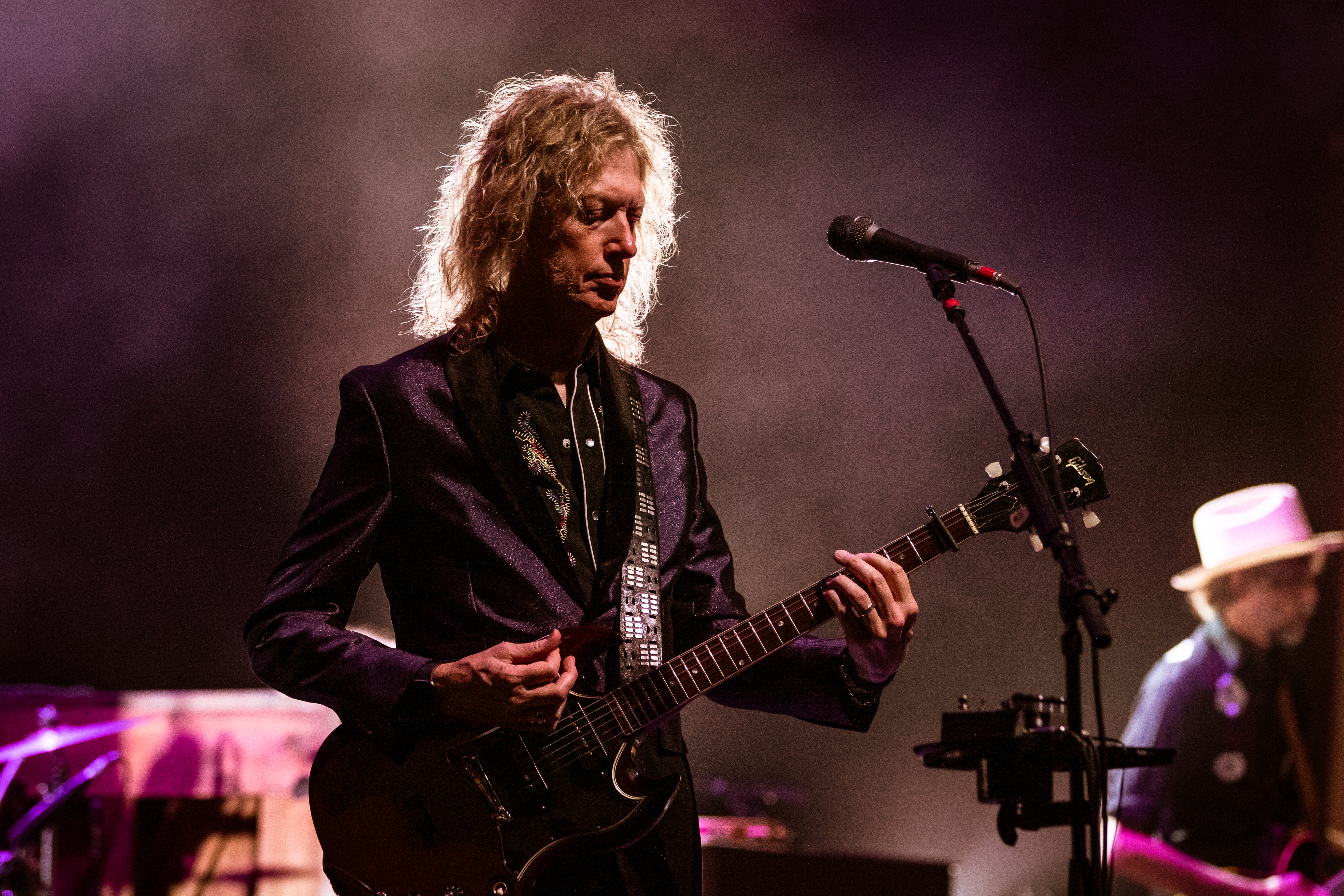
              “As you can clearly see / I’ve lost some luminosity / I hadn’t bargained for such intensity”

The opening lyric to Partly Of My Making bore a tangible irony that the audience seemed to relish. It’s not the easiest count if you’re dancing or swaying along but vocally the crowd gave as good as they got out of it. Had it not been demanded so emphatically the band probably could have gotten away without an encore, given the dazzling intensity of the first sixteen songs. But of course, they hadn’t played Apply Some Pressure by that point either and with each passing song and Smith’s energy waning there was a hint of disbelief when the moment finally came to close out the night with such a potent song. More than ever live music proves to be a healing force and Maximo Park know just how to deliver that vital medicine.

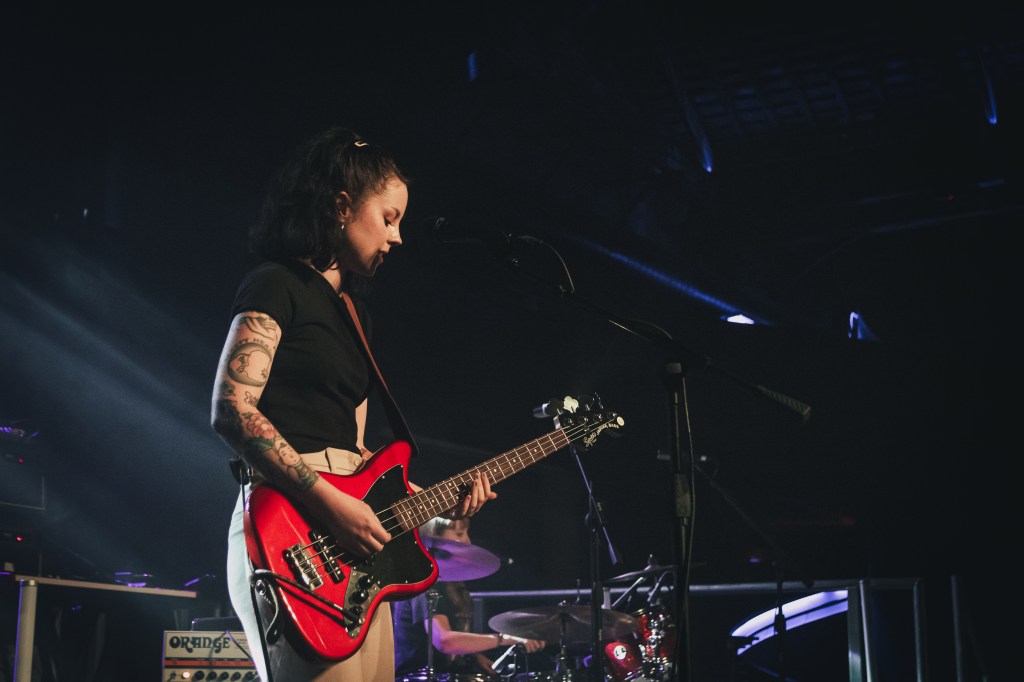
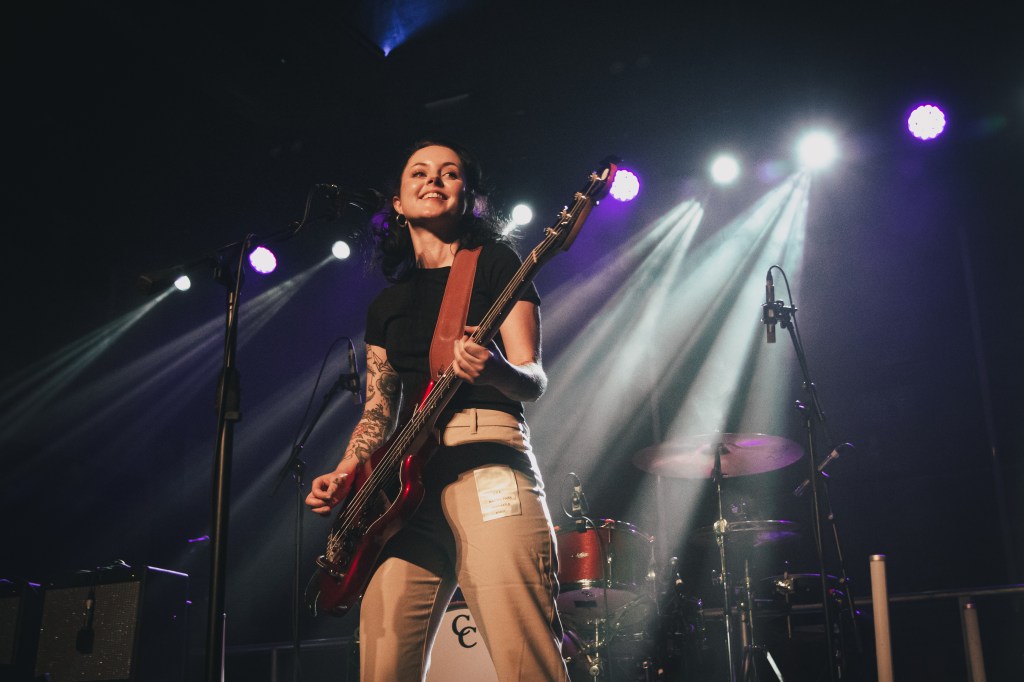
The Big Moon – Summerhall

Live music, Music Review

If there was ever any question over the popularity of guitar bands in the last few years consider this; The Big Moon are on their second round of touring through the UK since releasing their sophomore record at the beginning of January. And they’ve only gone and sold the place out! Following on from a successful run of shows supporting Bombay Bicycle Club earlier in the month they return to Scotland on the very last – leap – night of February to headline Edinburgh’s Summerhall.
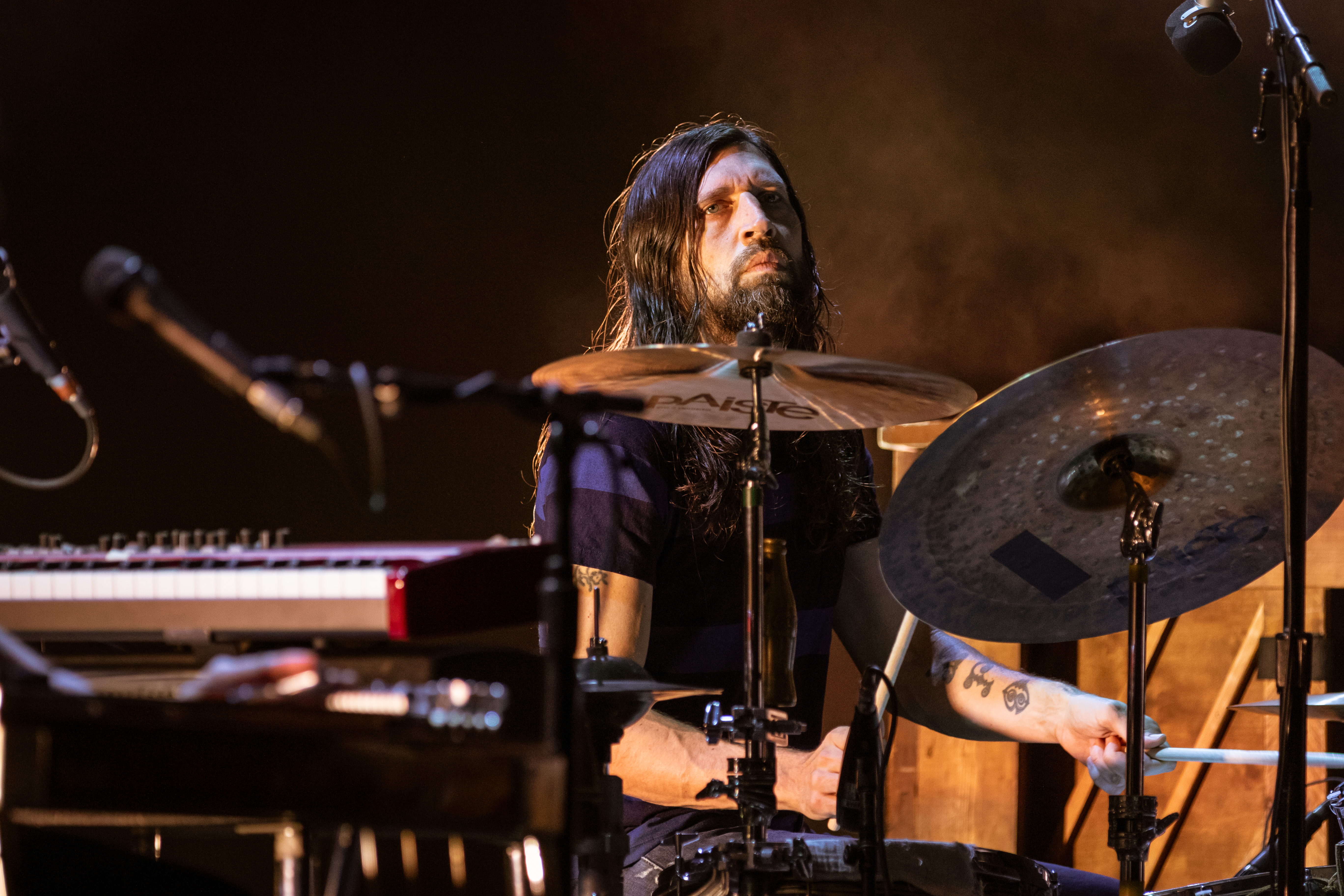
Anticipation is palpable with a queue snaking down the stairs and out into the courtyard. Fans are eager to get in early and snag a good position. They’re also keen to look the part and the merch table is already busy flogging t-shirts and albums; a positive sign for any artist in the streaming age but especially for new and breaking bands.

There’s a big portion of the audience already in place when tour support Prima Queen take to the stage. They don’t say much for the first few songs and only really get chatty before the end of the set when they mention that their bassist got dumped 20 minutes before soundcheck – “so rock’n’roll” – and that they put their band name on the drums because they forgot to mention it at previous shows. The mood is light and the band have a great chemistry on stage. Lead vocals are shared between guitarists Louise MacPhail and Kristin McFadden. They have that kind of effortlessly powerful command of harmonies, familiar to fans of boygenius and Alvvays, and with tones and melodies made for summer festival afternoons blissing out under blue skies. It’s a gentle kind of warm up set that closes out with “Milk Teeth” and “Mexico” and leaves the crowd slightly swaying, slightly nodding, ready for the main event.

From the moment The Big Moon appear there’s a buzzing warmth in the room. It’s not quite Beatles hysteria but it’s damn infectious! They meet that audience energy with the scratchy jangle of debut album opener Sucker which, despite its usual dynamic shifts, remains buoyant throughout. They follow up swiftly with the pulsing disco vibe of Don’t Think before settling into a lyrical groove with Take A Piece. The new songs are just as enthusiastically received as those from the band’s Mercury nominated 2017 release Love In The 4th Dimension despite being vastly different in both sound and subject matter. Of course in the live setting there’s minimal production to hide behind and every catchy chorus and driving guitar feels just as vibrant and raw as it should. Lyrically, Juliette Jackson’s direct and literal style is engaging whether lamenting youthful relationships, wrestling inner demons or staring defiantly into the void. Witty couplets cut through the repetitive choruses and reconnect the audience with the characters and emotions at the heart of each song. There’s flutes, there’s sing-alongs, there’s even a Fatboy Slim cover, either side of which Jackson is off the stage and down on the barrier leading “a gentle song with some yelling at the end” (Waves) followed by a riotous crowd favourite (Bonfire). The end comes around too quickly for fans who are vigorous in their applause and even after the last song, after the house music starts playing, are unwilling to accept that there won’t be an encore tonight. Naturally it’s disappointing for everyone who wanted to hear more from the band but there’s something so heartening about an authentic rock performance that elicits such an organic reaction from those present. It’s refreshing. It’s invigorating. It’s healthy. Guitar bands like Prima Queen and The Big Moon are good for the health of the industry.

Bear’s Den – Newcastle University Student Union

Live music, Music Review

On their second round of touring in the UK this year Bear’s Den have perfected a balance between arena rock and acoustic folk, packing out large clubs while performing with astonishing intimacy to an ever expanding and keenly devoted fan base.

The second-to-last night of this run finds the band, performing as a six-piece, in the rather sleek subterranean venue of Newcastle University’s Student Union. It’s not the grandest space they’ve entertained but it’s also not the shabbiest. From touring heavily in their early years, Bear’s Den have learned to work a lot of different rooms, on any given night of the year; a crowded university basement on a Sunday night is well within their command. And anyway there’s a kind of calm to November gigs that suits this music; when the nights start drawing in early, everyone switches to their heavier coats, as the air densifies with cold and skies become a little less stable. Summer isn’t long forgotten but folk are still happy to be indoors; it’s hygge season, and it’s the ideal climate for a Bear’s Den gig.

This evening’s kindling, the first of two support sets, is provided by Tusks, the spine-tingling musical endeavour of Londoner Emily Underhill. She’s on double duties tonight, opening the show and running the merch table, and yet with only 20 minutes allocated to get this one job done she doesn’t force a performance, easing herself and the audience gently into her mesmeric melodies. Underhill sings graciously through her register, at times slipping into a soft falsetto, but she is at her most affecting when she employs her high, full voice, as on the stunning title track to her latest LP Avalanche. Quieter moments like Demon (“…it’s actually a love song”) test the warmth of the early crowd and, gratefully, they seem to be thawing.

At 8pm the crowd has almost trebled, with a restless rabble engulfing the room as Flyte take to the stage. Although technically now a trio, since the departure of keyboardist/guitarist/vocalist Sam Berridge earlier this year, Flyte have maintained their full-bodied soundscape and delighted audiences throughout the summer with the addition of Jessica Staveley-Taylor (aka “Jess from The Staves” aka “one-third of The Staves”) into their line-up. Opening with a couple of songs from their debut album The Loved Ones, the set is kind of a slow burn up to White Roses, after which the crowd is a lot more settled and receptive. It’s just as well because the band follow this up with their breath-taking a capella cover of Alvvays’ Archie, Marry Me which, if you haven’t heard it, is about the kindest bit of self care you can offer your ears, at any time of year. Go; look it up now and feel the nourishment! They finish off with two crackers in Cathy Come Home and the glowing album opener Faithless.

The stage is dark before Bear’s Den emerge; a disorienting red aura fills the air as the unusually dramatic but iconic opening of Thus Spake Zarathustra heralds the main event. There’s no denying that this particular piece of music will heighten the anticipation of anyone’s arrival but Bear’s Den are not the showiest of bands, so it’s only fitting that they don’t actually walk on until the theme has played out in full; the gag is funnier when they don’t take it to that obvious, excessive conclusion. Humour is one of the band’s many charms.

Leading off with Fuel On The Fire, Elysium and Dew On The Vine, the set has a fairly similar running order to previous shows on the So that you might hear me tour, with the inclusion of two brand new tracks from the band’s forthcoming Only Son of the Falling Snow EP. The first of these is the title track which lead singer Andrew Davie describes as “a kind of Christmas carol, reflecting back over your life”. True to form, it’s a sorrowful meditation backed by some incongruous major chords and uplifting trumpet. It’s glorious. This is followed up with the – possibly even more exquisite – piano-lead ballad The Star of Bethnal Green, which takes its name from a pub adjacent the studio where Kev Jones conceived it. The lyrics paint love as a spiritual experience, at once inspiring, hopeful and comforting. Even in its relatively bare form it feels brighter than most songs in the Bear’s Den catalogue. And as festive folk songs go it’s no less than butterfly-inducing! It’d be show-stopping but Bear’s Den control their own inertia and it’s from here straight into Crow, a bona fide tear-jerker that depicts grief in a way that is uniquely Bear’s Den.

Davie has a knack for relating extraordinary human emotions through deeply personal experiences; his inclusion of very specific details, dates, names, locations, renders a stronger and more immediate connection to the particular events or relationships he’s recounting, as in Hiding Bottles and Above The Clouds of Pompeii, but his broader language leaves scenes open for listeners’ own attachments. This manner of lyricism, this telling-all-without-telling-everything style of writing is one of the reasons fans become so endeared to the band; seeing themselves and their lives in the songs, feeling connected in their shared humanity. At its very least live music is a communal experience.

The unpretentious, candid honesty of their delivery further sets the band apart, such as when they go “off-mic” to hear the crowd singing along to Magdelene. When they unplug completely to perform Don’t Let The Sun Steal You Away unamplified from the edge of the stage it receives one of the loudest rounds of applause all night, igniting the band and setting them on a skyward trajectory. These moments are unique to each crowd no matter how many times the band plays the same set of songs.

The Love That We Stole sounds bigger and bolder than it ever has. The guitars grow louder across Red Earth & Pouring Rain as heavy red light flickers. After the threatening and thunderous build on When You Break, driving and anthemic Auld Wives feels like respite. So much for the calm! The “last song” and “encore” are exposed as conventions but when the band return after a brief period of rousing applause they offer the sincerest and humblest thanks. And when they step out into the centre of the audience to perform Blankets of Sorrow they bring the communal experience to another level of intimacy. It’s a cosy place to be on a Sunday night in November.

The National – Castlefield Bowl

Live music, Music Review

On the third night of Manchester’s Sounds Of The City open air festival music fans who defied the forecast of evening showers were rewarded with an immersive and exhilarating performance by one of American indie rock’s keystone bands, The National. Opening their European summer tour with a one-off headline show ahead of some festival dates provided the band with a unique opportunity to showcase latest album I Am Easy To Find, while polishing up some old favourites, in front of an enthusiastic 8000-capacity crowd.

While many punters were still arriving the early support slot was filled by Nashville-based artist Adia Victoria. The singer spared no effort getting the crowd warmed up under the densely humid afternoon sky. Her sometimes-husky voice and sultry melodies, accompanied by occasional twirls and a sway of hips infused the performance with a powerful sensuality that contrast to the themes of songs like “Devil Is A Lie” and “The Needle’s Eye”. Finishing on the creeping groove of “Different Kind Of Love”, Victoria makes it clear she’s here for a good time, if not a long time.

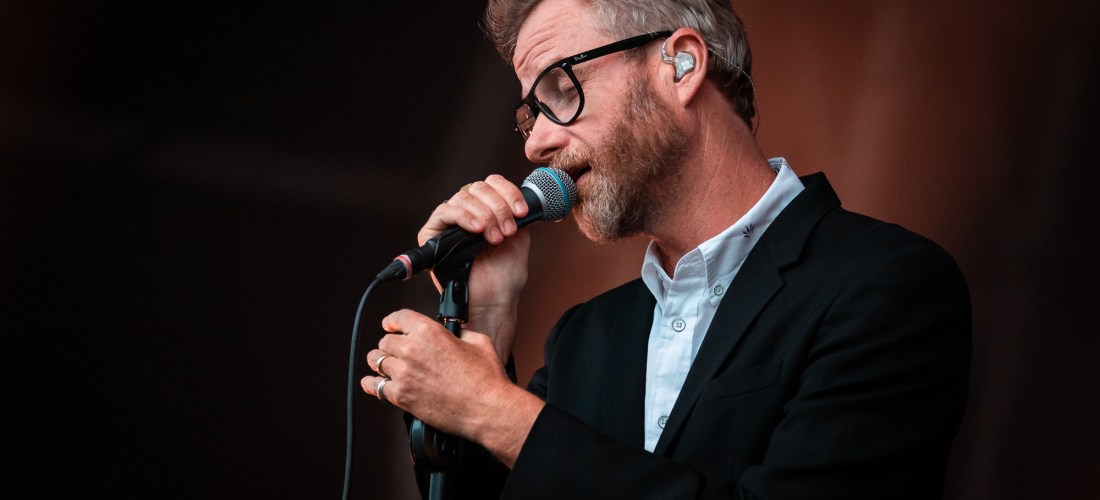
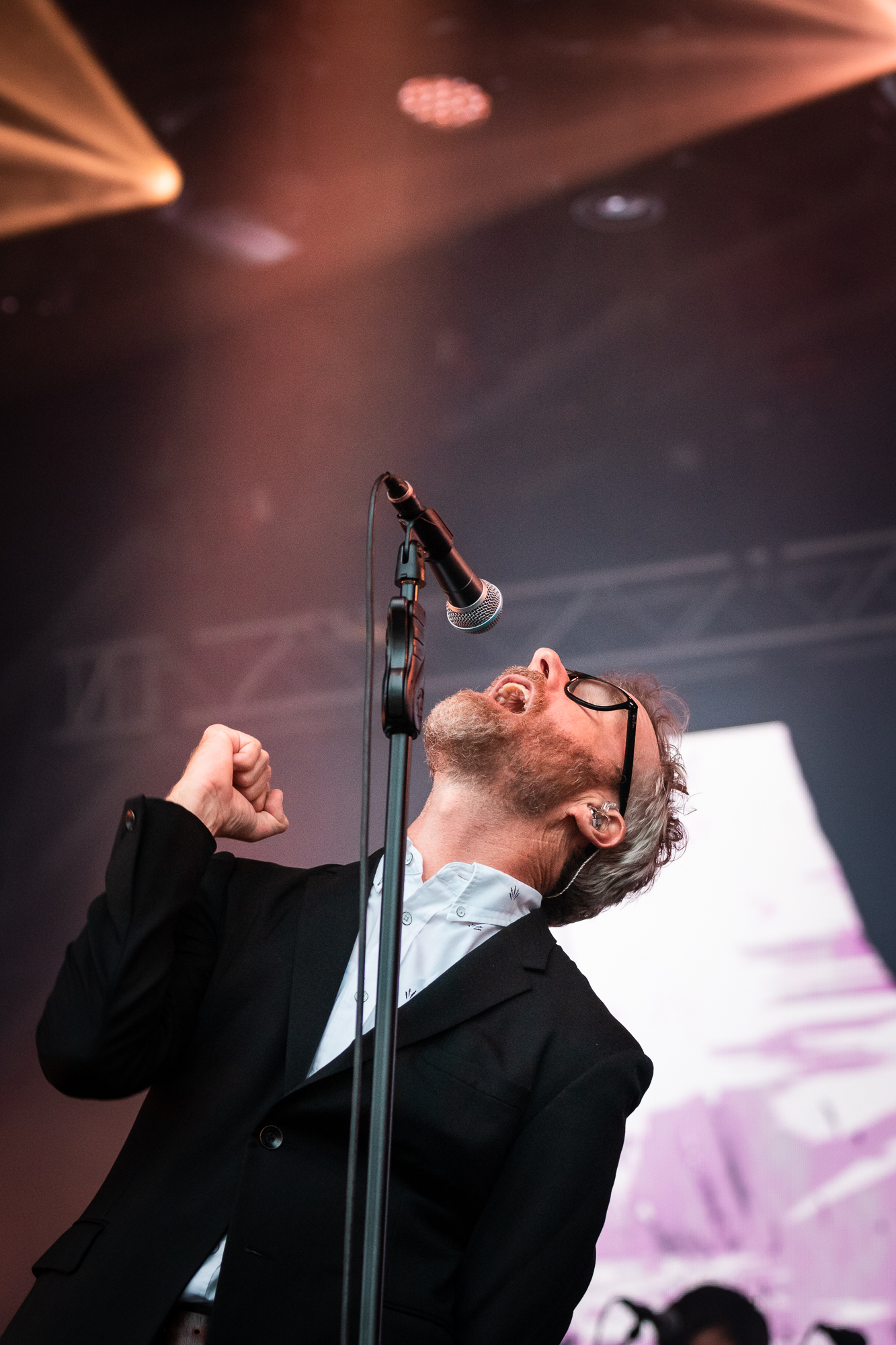
When the headliners take to the stage there’s a peculiar feeling of anticipation. Singer Matt Berninger appears to be in a light-hearted mood, ducking behind the piano as the crowd erupts in applause. The feeling shifts almost immediately to one of serious concentration as the band lead off with a string of songs from their latest album. It’s always a shock to the system when an established band comes to tour new material. That initial excitement and apprehension about what they will play and how it will flow weighs on both the performers and their audience. In this set of 25 songs 12 come from I Am Easy To Find. It’s a lot to take on and there are some sound issues throughout the first half of the set where Berninger’s vocals are occasionally drowned out by guitars, synths and horns. There’s a lot of words and a lot of voices and on no fewer than 3 instances the frontman concedes he messed up his part. Exchanging melodies and harmonies with 3 stunning female vocalists in Eve Owen, Mina Tindle and Gail Ann Dorsey gives the new songs like “Oblivions” and “Where Is Her Head” a much stronger sense of collaboration which stands out against some of the older tracks like “Bloodbuzz Ohio” and “Apartment Story”.

There’s a defiant sense of progress about the setlist too; not only are there a lot of new songs but there are fewer and fewer very old songs. One of the things fans love about seeing The National live is that, yes there are certain favourites they will always play but no 2 nights will ever be the same. The band change up their set for every single show and there’s always some unexpected treats from the catalogue. In Manchester these included “Green Gloves” and “All The Wine” which bookended some amusing chat from Berninger about capitalism after he exchanged his seemingly unpleasant drink with a fan in the front row.

Another standard of The National’s live show is the moment of insanity that ensues every time Matt Berninger wades into the crowd. It’s as exciting as it is terrifying and yet he does it so regularly that the band almost don’t notice, but that wingmen/guitarists Aaron and Bryce Dessner intuitively know when to occupy front and centre stage. “Day I Die” sees one such moment, after which Berninger appears quite dishevelled, his crisp white shirt untucked and his glasses skewed. Yet he returns again during “Graceless” where the microphone is all but lost to the crowd and his voice is barely heard over the shout-singing of those around him. His antics are especially jovial late in the set. During “The System Only Dreams In Total Darkness” he interferes with Aaron Dessner’s guitar change and finds himself flirting with the edge of the stage before running and leaping into position for the opening lyric. At one point he coaxes a phone from someone in the crowd, taking it on stage to film his perspective before tossing it back into the melee.

The band close out the set with “Fake Empire” and a new crowd favourite “Rylan” just as the heavy sky starts to give way to a light mist. Berninger’s protracted departure from the stage sees him handing a bottle of wine from his personal stash into the crowd, followed by some cups. “Now I don’t even have time to pee before the encore” he complains. Not leaving without playing a final couple of songs from the new album, they push on with the encore as Berninger enters the crowd one final time during “Mr November”. He emerges at the end of it a somewhat changed man, mainly in that he is unable to hear the band clearly or keep up with “Terrible Love” until well into the bridge, at which point the Dessner’s take over and drown out whatever vocals remain to be heard.

Shenanigans have cost them time and as they set up the final songs, a typical crowd singalong with “Vanderlyle Crybaby Geeks” the venue hits its 10.30pm curfew and all amplification is silenced. Lights come on as the crowd leads line after line, drowning out all but a faint tambourine on the stage that keeps time until the last note is sung. Rain falls heavier, the louder the chorus rises until finally the gathering disperses by mutual agreement. Another one-of-a-kind night for fans, if not quite an auspicious show to kick off this tour.

Sheryl Crow – Glasgow Royal Concert Hall

Live music, Music Review

Having recently opened shows for the likes of legendary artists Phil Collins and the Eagles, Sheryl Crow is grateful to be back in front of her own audience for a while. With the promise of a two-hour set featuring “a bunch of old things and…some new things too” regulars know to expect a great night. For first-timers the setlist, front heavy with mega hits like “If It Makes You Happy” and “All I Wanna Do”, is a shock to the system and an assertive reminder of why Crow, now in her late 50s, has maintained a position as one of the most revered and sought-after songwriters and female vocalists for over 2 decades.

Her energy and enthusiasm is relentless and it’s clear Crow still enjoys playing the older songs. The crowd reacts with lively call and response singalongs and dancing in the aisles. Crow acknowledges, engaging audience participation, for at least as much as she can understand of the Glasgow accent and vernacular. She shies away from recent albums for the most part but introduces a few tracks from her forthcoming release Threads, due at the end of August. The first of these is “Prove You Wrong”, a collaboration with country star Maren Morris and rock veteran Stevie Nicks. It has an instant classic rock feel that tends a little formulaic towards the end but is no less enjoyable in the context of modern rock radio playlists. Another new single, “Live Wire”, comes under the blues influence of its contributors Bonnie Raitt and Mavis Staples, and is introduced with a cracking anecdote from the recording session with Staples. As one of the slower songs in the set – and it’s by no means a ballad – “Live Wire” is evidence that Crow still has the skill to craft a meaningful and catchy song without sounding like a rehash of former glories or a nostalgic tribute to the successes of youth.

Despite adhering mostly to the acoustic guitar throughout, Crow’s knack for creating rock anthems is indisputable and well supported by her six-piece band that includes two lead guitarists of equal genius in Audley Freed and Peter Stroud; the latter garnering extra attention from the singer for his “snazzy jacket” in addition to his expertise with the six-string. The sound is further embellished with Joshua Grange on pedal steel, Jen Gunderman on piano and Robert Kearns providing bass and particularly stand out vocals as a substitute for Joe Walsh on new duet “Still The Good Old Days”, a song that Crow admits is “about being my age”. Yet the clarity and ease of her voice on the opening of “The Difficult Kind” shows an ageless strength and beauty; her voice is as good as it’s ever been. Sadly, there are times when the full force of the band is too much and Crow’s still-powerful vocal is overwhelmed, mainly by the treble of her own guitar. It’s disappointing to experience this in a room like the Concert Hall which usually delivers perfectly balanced levels, for any genre or musical style. Nevertheless the crowd is on her side and she receives a standing ovation before she’s even finished the set. Admittedly, the performance of “Best Of Times” is well deserving; Crow takes her microphone from its stand and commands the stage from end to end with multiple charged harmonica solos, set against intense strobing as the band gathers around the drum kit to pool and play off  their collective energies.

The final song of the set, “Steve McQueen”, features Crow playing a glittery red, white and blue electric guitar while her two sons – acting as occasional guitar techs throughout the night – join in on maracas from behind the keyboards. When she returns for an encore she mentions that they spent their day over at the Glasgow Science Centre and had a great time taking in the city. She dedicates “Soak Up The Sun” to her Glasgow audience in honour of the beautiful weather, before closing out with a grand rendition of “Real Gone”. The crowd need no further persuasion and remain on their feet for the duration. Warmly received at the top of the show is Hebridean singer-songwriter Colin MacLeod, himself no stranger to opening some pretty big stages, having supported the likes of Van Morrison, Robert Plant and Roger Waters in the last twelve months alone. He played a brief but beautiful solo set of melancholic-sounding songs, drawn mainly from his 2018 debut Bloodlines, with two new songs performed on acoustic guitar sandwiched into the middle of his set. MacLeod shows himself to be a versatile performer; an accomplished guitarist as well as a gifted storyteller and songwriter, with a voice as warm and mellow as a 21 year old single malt.

Idlewild – Aberdeen Music Hall

Live music, Music Review

On the weekend that Idlewild released their latest album Interview Music they played 3 separate sets in Aberdeen; two at the AECC for the BrewDog shareholders’ AGM and one semi-acoustic instore at HMV. Whether by coincidence or by design they also rounded out the UK leg of their Interview Music tour at the city’s recently transformed Music Hall on Sunday night with a rousing set of modern classics and old favourites.

The XCERTS had the privilege and responsibility of getting the bank holiday crowd warmed up for one of their own favourite bands, which proved to be more than within their capabilities. The three-piece, originally from Aberdeen, have been sailing a sea of praise since their fourth album Hold On To Your Heart was released at the beginning of 2018. Their unapologetically ripe blend of instantly sing-a-long-able choruses, almost-familiar riffs and heart-on-sleeve lyrics on this album and subsequent out-takes EP, Wildheart Dreaming, seem to connect with even the grittiest of old school Idlewild supporters. There’s no denying Murray MacLeod’s stunning vocal is the centrepiece of these songs; whether rocking out on upbeat openers Daydream and the Petty-esque Drive Me Wild, or crooning through piano-lead power ballad The Dark, his delivery is loaded with melodrama and earnest romanticism. The ten-song set rushes by to close with the irresistible a cappella chorus of Feels Like Falling In Love. Job done. The crowd is suitably thawed.

Following a career highlight tenth show at the Barrowlands in Glasgow the night before Idlewild seem astonishingly relaxed when they take to the Music Hall stage. Their energy and resolve is not diminished any by the previous night’s antics however and they set straight to task bringing Interview Music alive for their assembled followers. Dream Variations introduces the new album straight away with equal measures of everything this band is about in 2019; a rock-solid rhythm section, duelling guitars and piano, soaring harmonies and, of course, Roddy Woomble’s abstract lyricism. A curious feature on the new album that comes into play further as the set progresses is the mid-song change-up; a different tempo, a different energy, new melodic ideas break through. The title track takes one of these moments to catch its breath before launching an all out sonic assault. It’s not out of place, more a reminder that the band still love to jam, still love to throw everything into their performance.

New songs are few and far between, for being an album-specific tour, but where they do come they’re well received by the Aberdonian crowd. Woomble points out that the record sold particularly well in the city, so it’s unsurprising to see so many people singing along. Radio single Same Things Twice sees fists in the air and voices raised as if it’s been in the set for the last decade. Admittedly, it has one of the catchiest choruses on the new album, and live it takes on a coarseness and density to rival anything off 100 Broken Windows. Indeed songs like Roseability and Little Discourage elicit spontaneous pitch perfect sing-a-longs and the crowd need little prompting to join in when Woomble says he’s needing support on Live In A Hiding Place. Another mid-set highlight is the frenetic and angular A Ghost In The Arcade. Washed in strobing green, white and blue lights, it closes with a rambunctious solo from guitarist, Rod Jones, and finds Woomble watching on not from his usual shadowy side-of-stage vantage point but from the front corner of the stage; an indication of just how relaxed he is within the performance.

From the point of American English the set takes off on a melodic upward trajectory, buoyed by the crowd and reciprocated by the band. It leaps from El Capitan to yet another reworked rendition of the fan favourite When I Argue I See Shapes, altogether faster and fuzzier than on the previous tour but still not as messy as the original. This could be its best incarnation yet.

The band wave a brief “thank you and goodnight” but don’t waste much time before returning for their encore. They still have a lot to deliver but spare some grace to introduce the first song, in tribute to Scott Hutchison, a cover of the gut-punching Frightened Rabbit anthem Head Rolls Off. It’s powerfully uplifting from start to finish, leaving many faces scorched with defiantly jubilant tears. The encore is relentless rock after that, wringing out every last ounce of love from either side of the barrier. As if the band had something to prove. Finishing with In Remote Part / Scottish Fiction there’s still a sense that the band could come back for a second encore and the crowd are restless and demanding until the house lights finally come on. It’s enough, for now. They’ll probably be back; seems they quite like playing Aberdeen. And they would be welcome, any time.

Travis; The Man Who 19th Anniversary – SSE Hydro

Live music, Music Review

You don’t need an excuse to listen to Travis’ 1999 sophomore album The Man Who; it’s a beautiful, timeless record loaded with endearing melodies, vibrant acoustic guitars and po-faced love songs. It’s the sort of album you listen to because you still like it, because you can’t remember a time when you didn’t like it, and probably because you can remember a time in your life when it didn’t exist and that time wasn’t as good. It’s polarising in that sense; life before and life after The Man Who. Music before, and music after. If you’ve welcomed this album into your life then you know what I’m talking about. Released in the wake of Britpop when pastiche was less of a trend, The Man Who marked a turning point, or at least a dividing line, in pop music. Without any knowing guidance, and despite being sonically informed by Oasis at the time, Travis came to define the sensitive sound of the four-piece male rock band at the turn of the century. Their iconic songs, loved or loathed, dominated radio the world over and lead the way for so many bands to follow from Coldplay through Snow Patrol and up to Mumford & Sons.

In light of this then, Travis themselves need no excuse to celebrate and tour the album that launched them into the pop-rock stratosphere so many years ago. 19 years ago, in fact. 19 is not a significant anniversary but The Man Who is a great album so why not? Fans want to hear it, the band want to play it. The music economy doesn’t get simpler than that these days. A run of shows earlier in the summer took in numerous venues across England, as well as some festival slots, so the final two-weeks of 2018 bring them around again and home to Glasgow’s SSE Hydro just in time for Christmas, and 2 years to the day since they last played here on the Everything At Once Tour.

Isle of Lewis singer songwriter Colin Macleod released one of the year’s best albums in Bloodlines and as the first of two supports for the night he delivers stripped back renditions of five songs from the record, as well as a melancholy interpretation of Ring of Fire. Beautifully understated and delicate from beginning to end, his set feels naturally calm amid the excitement and anticipation of the evening. He concedes his own disbelief at opening the show, admitting that Writing To Reach You was the first song he ever played. Right now though his own songcraft is fully matured and his confidence on stage serves him well, alone in the spotlight.

The second support are relative “old favourites” of Travis’ audience, and certainly owe a debt to the acoustic rock path paved by The Man Who. That said Turin Brakes have never stood in the shadows and since touring with Travis in 2001 they have remained friends and contemporaries, not rivals. Their divergent musical roads couldn’t be better exemplified than in tonight’s performance. A 10-song set draws from across their catalogue, never focussing heavily on one period and certainly not trading on nostalgia, but rather offering a cohesive sonic representation of where the band are now. And it’s a great sound. They’ve always been known to indulge their rock tendencies in the live setting and tonight is no exception. They’re clearly having a lot of fun; whether it’s because they’re out to impress as a support act, or because they don’t have the pressure of headlining, it doesn’t seem to matter, their performance is top shelf. Older hits like Painkiller and Underdog are reworked with fresh intros and some mint distortion on the acoustic guitars. If anyone walked in during Black Rabbit expecting a Travis concert they’d be very surprised by the rambling proggy jam happening on stage. It keeps on the sunny side of excess though and the band are sent off with just the appropriate level of enthusiasm ahead of the main act.

I want to be objective about what happened next but there’s an obvious reason I bought a ticket for this show. Here instead are some facts about the gig:

Between support sets Fran Healy came out to the barrier and met fans, shook hands, posed for photos, signed things, chatted to people.

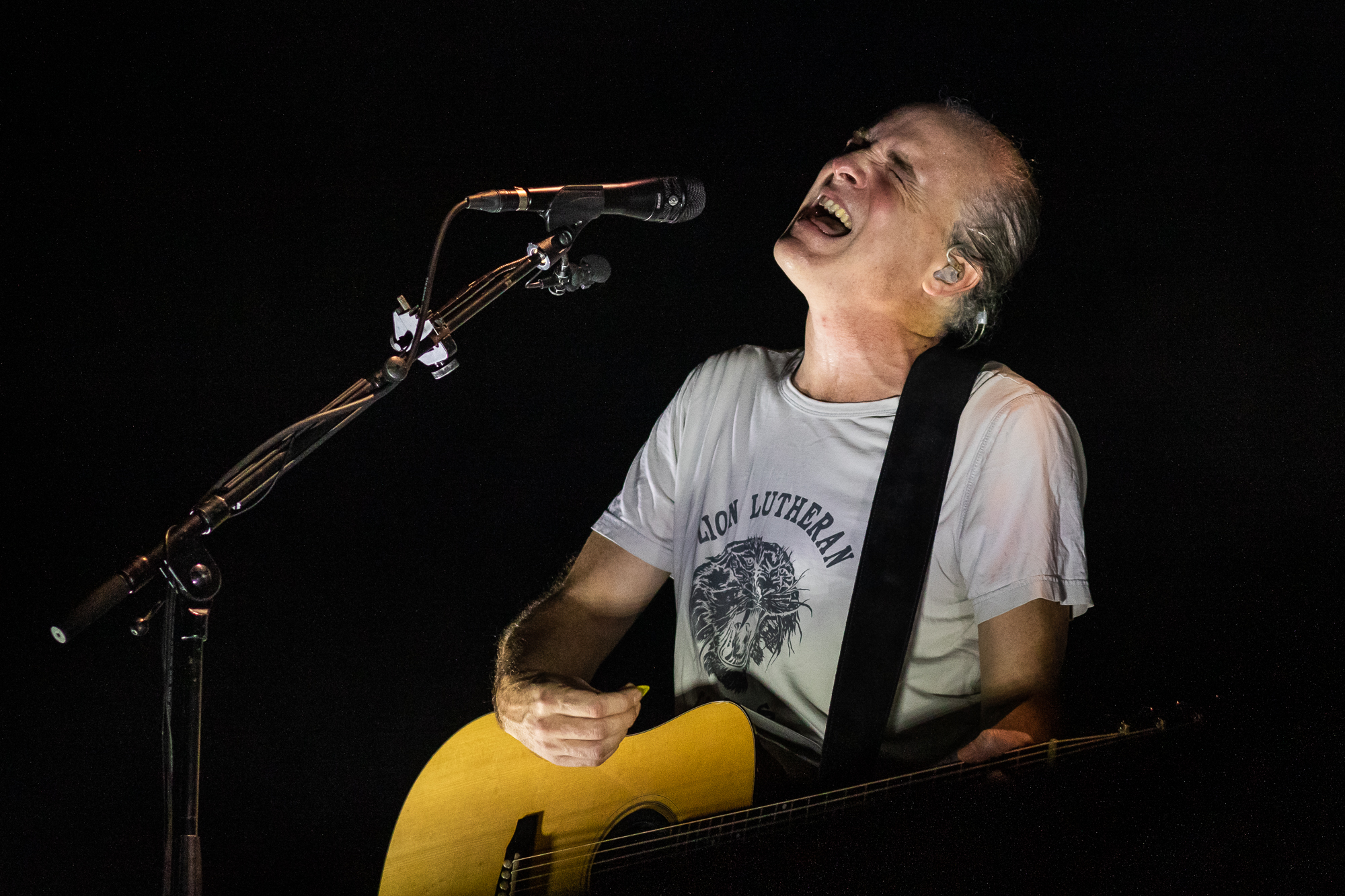
On stage Fran wore a kilt and a “Zion Lutheran Cougars” t-shirt identical to the one he wore in the video for Why Does It Always Rain On Me?

Andy Dunlop got very sweaty, very quickly.

Dougie Payne smiled a lot.

The band played The Man Who from start to finish, including its hidden track Blue Flashing Light, and then left the stage.

The second half of the set comprised a “best of” selection of singles and closed with a Christmas medley, accompanied by a couple of brawling jakey Santas.

But what was it like? Well honestly, it was pretty special. The nature of a start to end album show is that inevitably a band has to play their hits as they lie, i.e. Driftwood, Turn and Why Does It Always Rain On Me? went out in the first half. It’s unorthodox to play your biggest single in the first hour of your show and it felt a bit strange to be pogo-ing  so early in the night but the other side of this is that the band get to play some songs that otherwise wouldn’t make it onto the usual setlist. I haven’t heard Last Laugh of the Laughter in years and the harmonies were sweeter than I can ever remember. It was perhaps the only song that sounded different from the album version, and only because of the strength of the backing vocals, the rest was very true to the original sound. Another take on this format is that some of the band’s more challenging songs also have to come out. Much as they might be endeared to the hardcore fandom moments like Luv and She’s So Strange were reminders of why The Man Who was critically derided as a collection of “sad” “ballads”, the latter in particular proving a bit of a stretch for Fran’s vocal chords. But there were fond memories and pleasing anecdotes to go along with these old songs and the band have never lost their wondrous humour which always keeps their live shows so engaging and entertaining.

The second half of the set highlighted a few other things about The Man Who. Firstly, that the significance of the album to fans cannot be understated; once upon a time these were some of the only Travis songs in existence and they were adored mightily and whole-heartedly which, in the context of the live show, means the album falls so naturally and familiarly on the ears that it sounds like a “best of” in itself, even up against the established singles like Side and Closer. Every song is so well received. Secondly, that Travis’ true nature has always been as a rock band. From the opening chord of Blue Flashing Light the atmosphere in the arena is completely changed, electrified, amplified. The Man Who happens to be a cohesive collection of quiet songs and there are many others in the catalogue (see The Invisible Band) but when given a platform, or an entire half a set, the band choose to play loud, choose to rock out, choose guitar solos, choose to traverse the stage, choose to jump off the drum kit. The Man Who is another side to that band but it was never the limit of their abilities or interests. Lastly, that Travis are a band from Glasgow and were they not, they would never have written as iconic a song as Why Does It Always Rain On Me? because where else in the world could they have found inspiration in the best audience of voices to belt out such an anthem?

Jeff Wayne’s The War Of The Worlds – SSE Hydro

Live music, Music Review

As a young child I visited the cassette drawer of my parents’ entertainment unit regularly. It contained so many treasures; a selection of Neil Diamond albums; various ABC Radio compilations; a cleverly duplicated copy of the Young Einstein soundtrack; the all important head-cleaning tape and fluid pack and multiple anti-static cloths for our records. Buried in the back right-hand corner, presumably because it didn’t fit the individual slots of the cassette trays, there was a double album that intrigued me for a long time. When I finally enquired with my Mum about this block of tapes – I hadn’t seen a double album on tape before, it was a block – she related to me the story of how The War of the Worlds had been broadcast as a radio play in the 1930s and caused mass panic, even alleged suicide, because people thought an alien invasion was taking place. I found that story absolutely terrifying. From then on I regarded that double album with a kind of universal fear that I couldn’t even understand.

I must have been about 10 or 11 years old the first time I felt bravely curious enough to listen to that album. The album was, of course, Jeff Wayne’s Musical Adaptation of The War of the Worlds: Not nearly as terrifying as an American radio play adapted from H.G. Wells original invasion novel. Or so I told myself. You know that way frightened children rationalise with themselves about the dark? “There’s nothing to be afraid of” I told myself as the notorious “Ullas” sounded. I nearly survived Tape 1, Side A before turning it off. I made several more attempts but couldn’t get my stomach beyond the notion of that chorus; “But still, they come!”

When I was a little older, maybe 14 or 15, and in the prime of my teen horror film phase I discovered this album again in the record collection of my best friend’s parents. Late one Saturday night while sleeping over with a couple of other girl friends, after a binge of scary movies, we decided to put it on. This time I got all the way to turning over to Side B and was just about to drop the needle when one of the others girls interrupted, “Do we have to? I really don’t like it; it’s scary.” We let it go for the night and later, when it was just me and my best friend, we played Side B. But by the end of that we were bored. The musical themes were still dramatic and frightening, and the narration eerily haunting, but in the light of Sunday afternoon it just didn’t seem as interesting.

It was a long time before I revisited TWOTW, it was on the same long haul flight where I first listened to Mike Oldfield’s Tubular Bells in full. I had some time to kill. In the confines of the plane I drifted in and out of consciousness and in and out of the nightmarish commentary. When I eventually came around for a meal service the album was somewhere in the middle of its third or fourth repeat, so I can definitely say I’ve played it all the way through. In my memory though it’s still a terrifying listen. Even the titles of the songs/chapters give me chills; one mention of a “heat ray” and I get that sinking feeling in my stomach. There’s no question in my mind: It is a masterpiece! A truly haunting masterpiece.

Never in all these years did I imagine seeing a live stage production of something that so traumatised me as a child. Yet, when the 40th Anniversary arena tour was announced I knew I needed to see it. I could think of no better way to experience this album than in a vast chamber with enormous light and sound capacity, surrounded by an audience of thousands. Yes, this would be the perfect environment to conquer my fear of the “Fighting Machines”.

I had no idea what to expect and for my own enjoyment, or perhaps torture, I didn’t look into the previous stage productions. I wanted to engage with the performance, fresh and naive, like I had done with the album. And really, I did. At first the simplicity of the set appeared disappointingly dull.

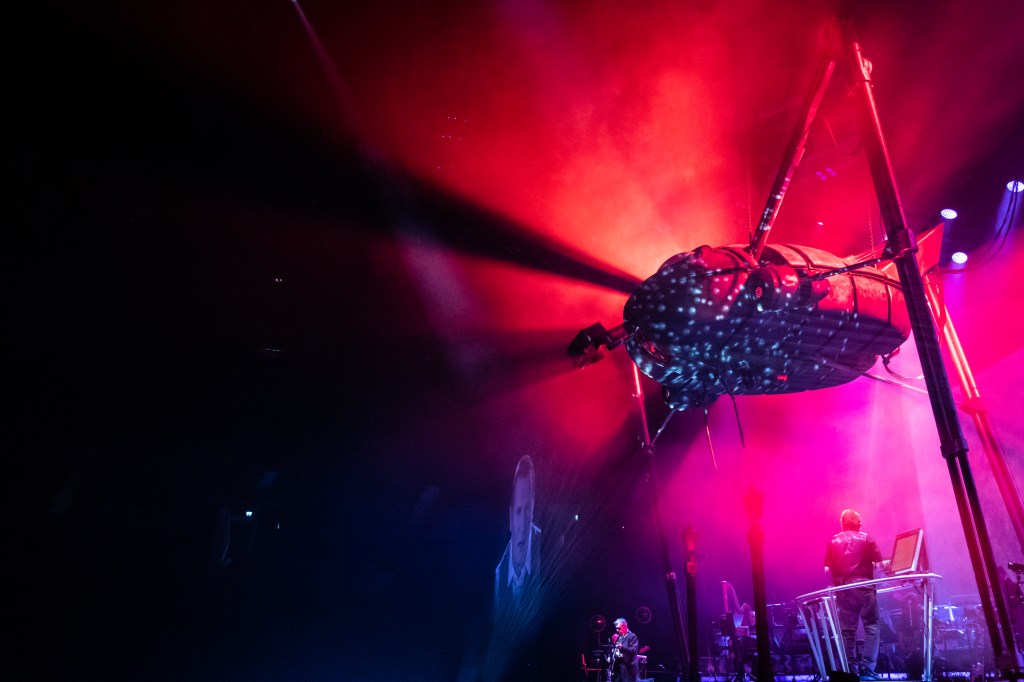
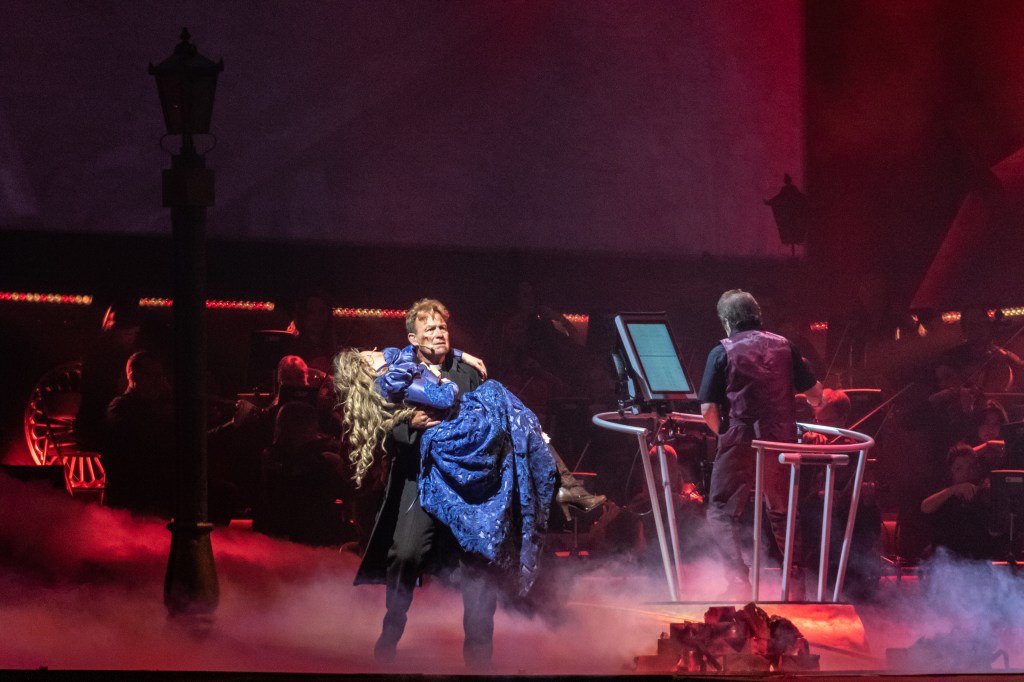
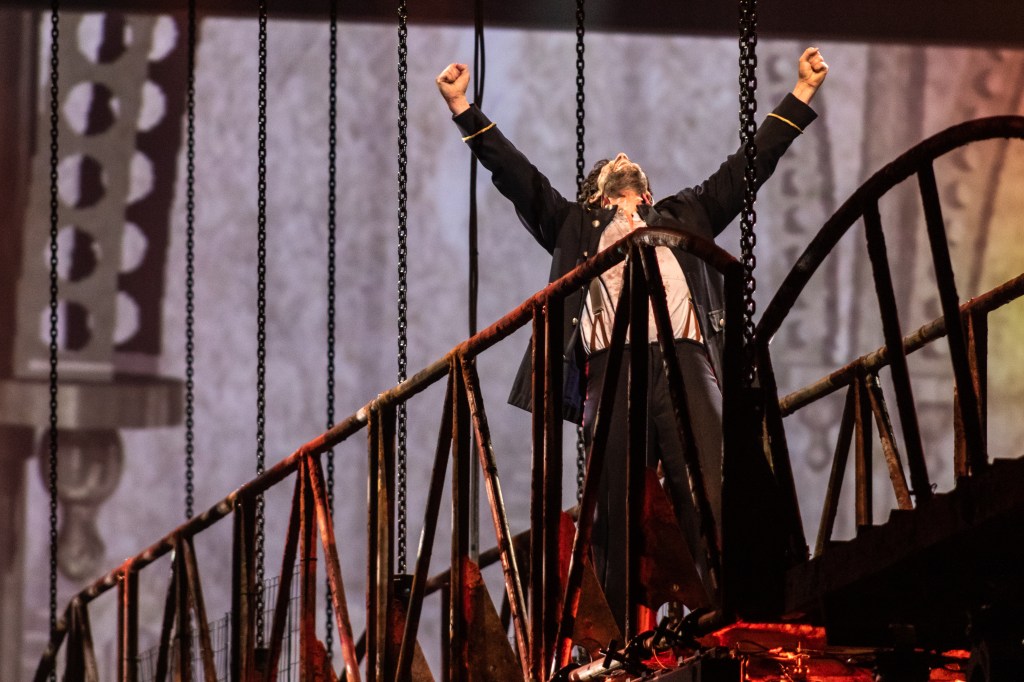
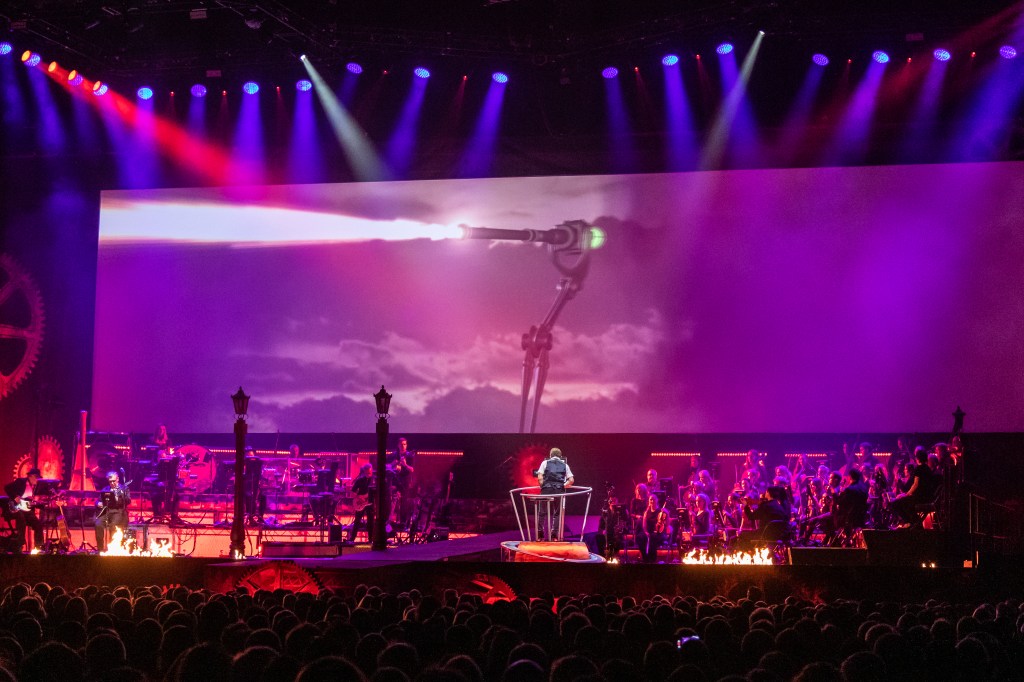
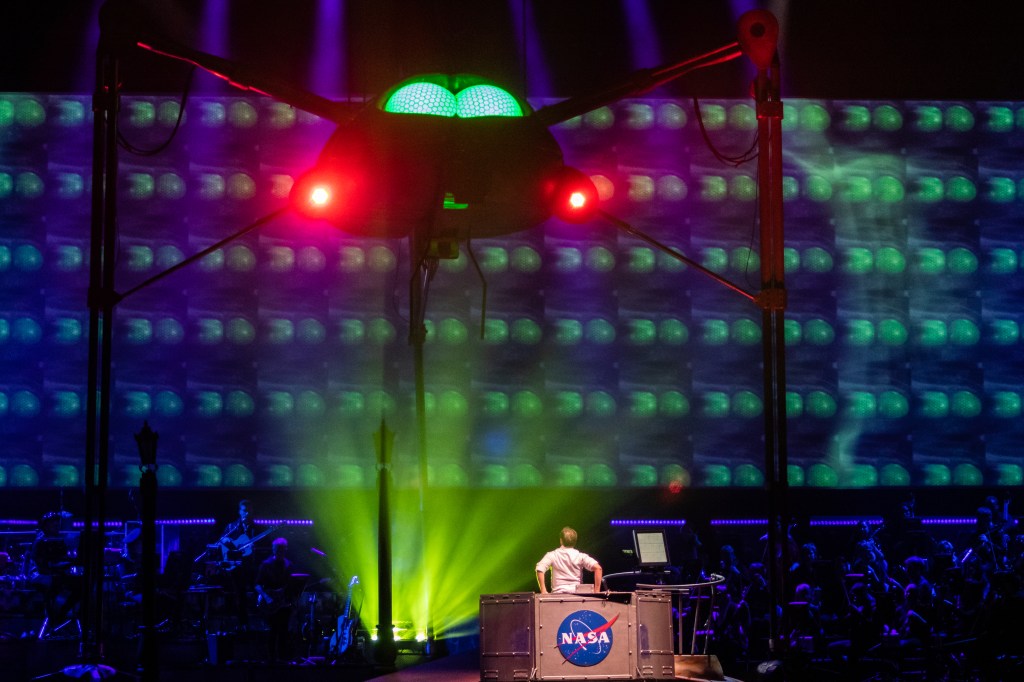
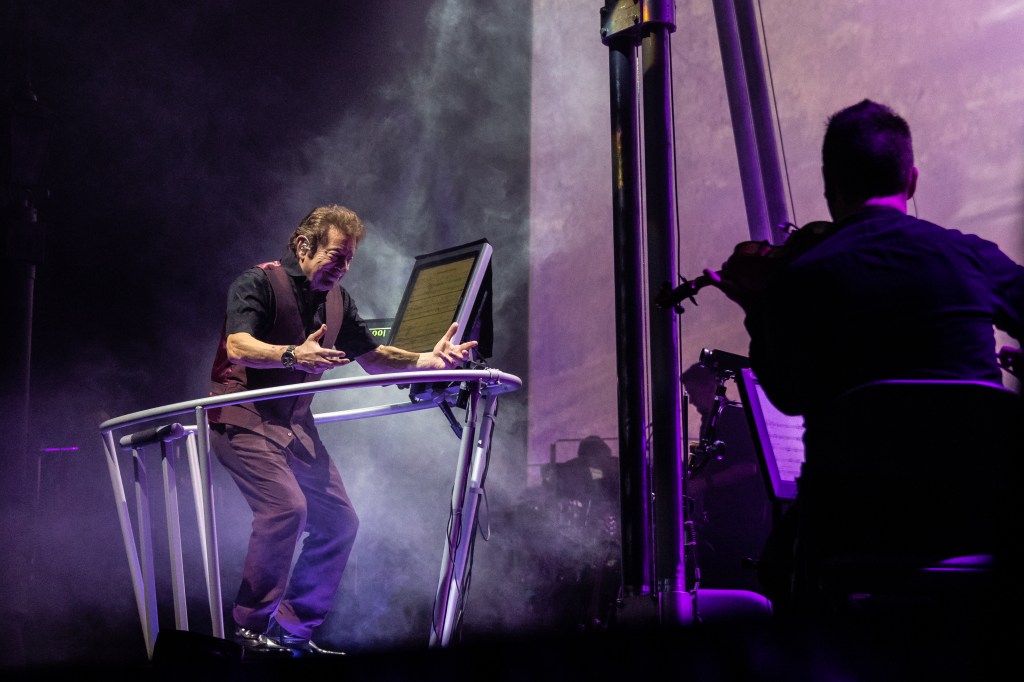
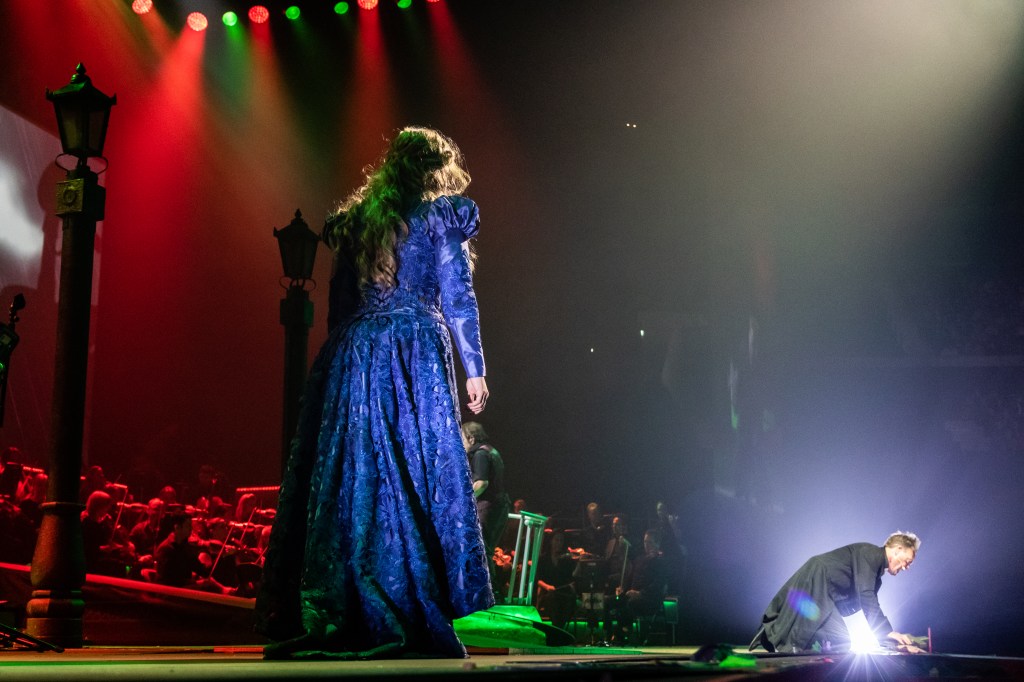
A ramp from the back of the stage running between two lamp posts lead the actors into position in front of the band, string orchestra and conductor, while a secondary stage in the centre of the arena was bare. However, as my eyes adjusted to the contrasting light from the large screens behind and on either side of the stage I began to see the finer details. Giant cogs, metal discs, scaffold railings, beams and pillars, adorned the stage surrounds with an industrial charm.

The musicians were often silhouetted but occasional highlights would reveal some glamorous fabrics. The cast, as they featured one-by-one, or at times in pairs, were all fully characterised by their respective wardrobes. And the visuals projected on the screens were loaded with detail and stimulation, particularly fitting to the pace of the narration. In some moments of intense action the density of the production was nearly overwhelming; there was so much to take in. A street scene of destruction featuring “Jeff’s Music  Emporium” was one of those moments where your eyes could have been watching anything and you would have seen so much, but missed so much at the same time.

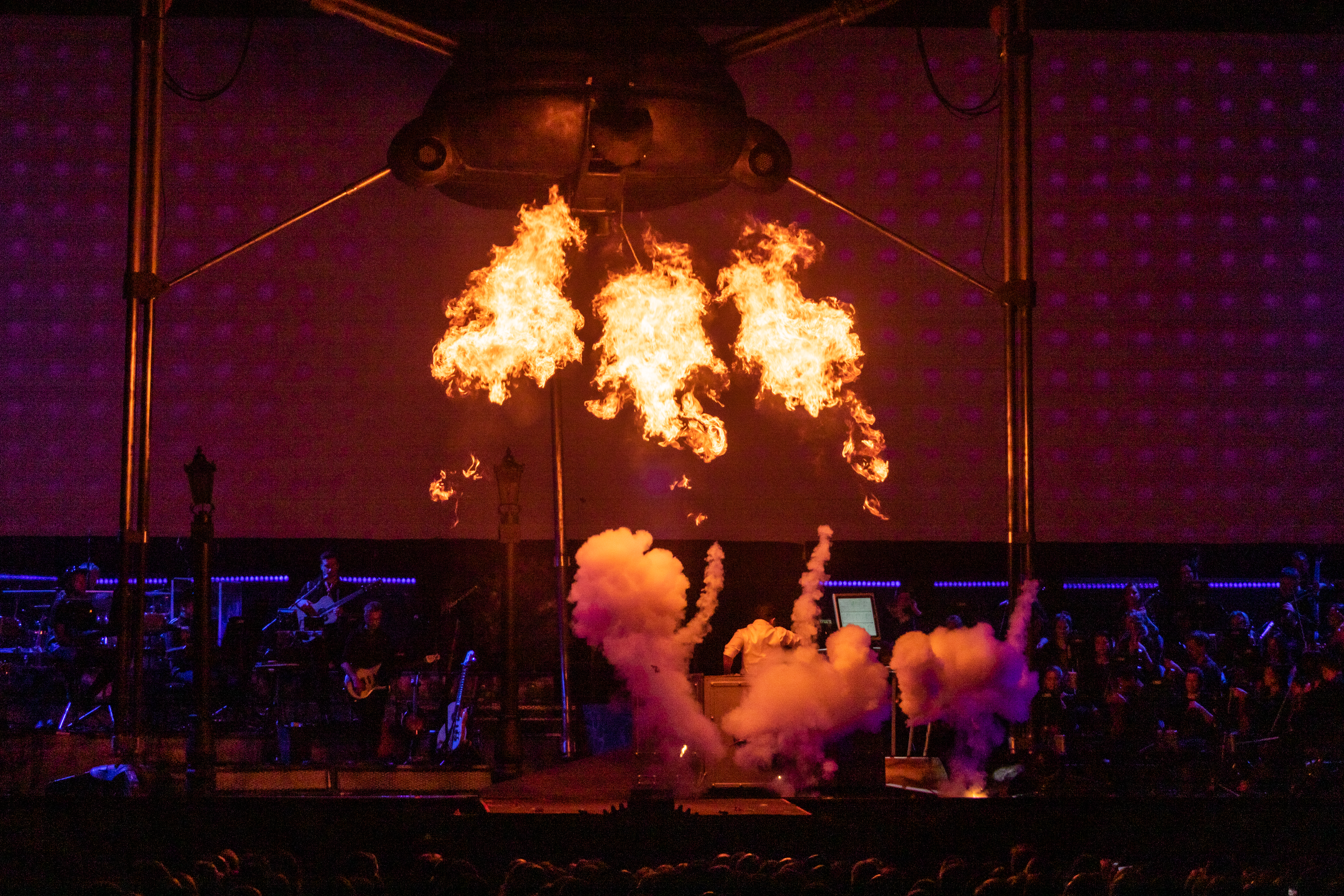
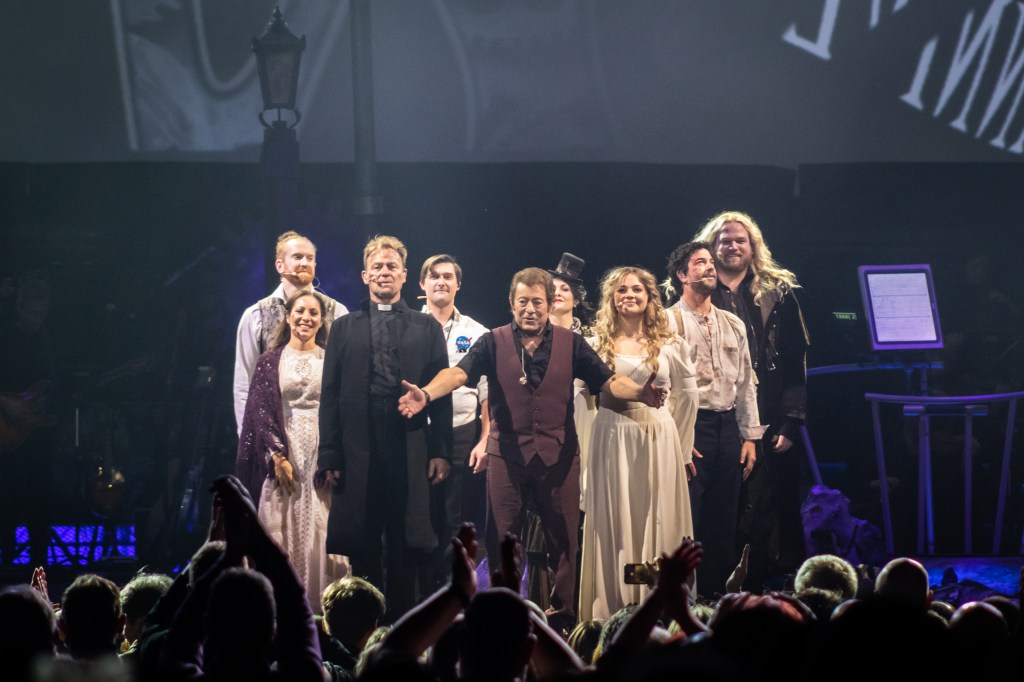
 As it turned out the scale of the set was just right for The Hydro. The measure of this was when the Martian Fighting Machine descended upon the stage, unleashing fiery blasts, the heat from which could be felt across the entire stalls and beyond. I have to be completely honest; my jaw hit the floor when I saw that thing coming down! My heart rate was already elevated from the tension of the story; the unscrewing of the first cylinder, the panic at the use of the heat ray; seeing a life-sized alien craft standing right before my eyes was quite extraordinary. I may have lost my breath for just a moment.

The accompanying sound too, was beyond my imagining. I could physically feel the landing of each cylinder, every explosion, and the Thunder Child certainly lived up to its name. The bone-melting cry from the Martians was enough to induce prog-rock sci-fi nightmares for at least another 4 decades to come. Musically I couldn’t fault the performance and the engineers really controlled the sound well. Original session guitarist, Chris Spedding, and bassist, Herbie Flowers, delivered their iconic parts with incredible vitality and effortlessness. I can imagine some fans of the original recording might be put out by the addition of new music (Life Begins Again was introduced in the 2014 production) but I’d like to think fans of this musical style, and the way the story develops through the music, can appreciate Jeff Wayne’s desire to grow his work and legacy through the evolution of the live performance.

As the show went on I became increasingly conscious of the wonderfully effective synchronicity between light and sound; not just in the obvious and violent moments, as in the flashes of destruction and battle, but through the more passive sequences too. The heavy stillness on stage as the alien red weed covered the landscape was so subtle but so crucial to the changing atmosphere at the beginning of the second act. The darkness over the band during the Forever Autumn Reprise duet created a magical moment between just The Journalist, the endeared narrator, and his distant fiancée.

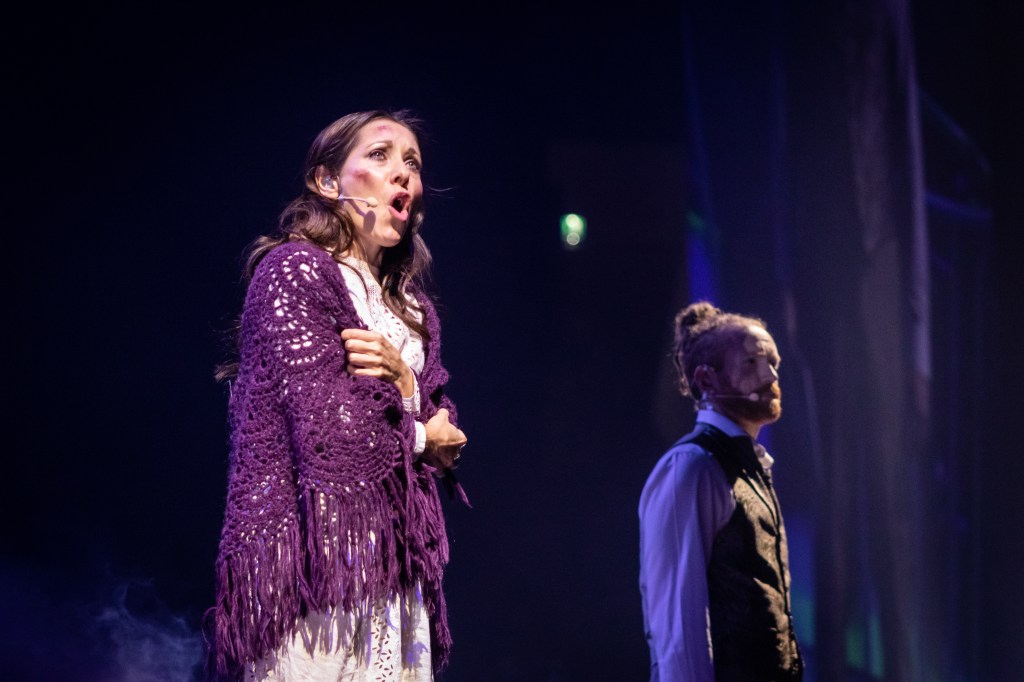
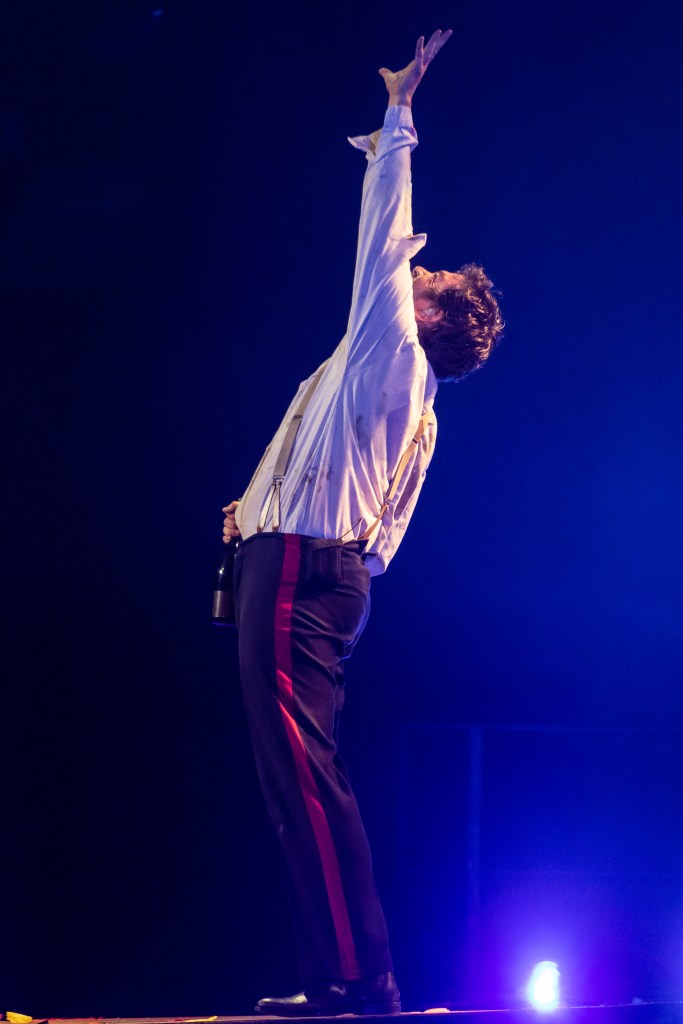
Having said I didn’t know what to expect going in, I was familiar with many of the performers, and I was still really impressed. Jason Donovan portrayed the grotesque anger and distressing confusion of Parson Nathaniel to the point of apparent fatigue. I was exhausted by the end of his frantic ravings. Playing opposite the delightful airiness of Carrie Hope Fletcher really emphasised the conflicted rage of his character; the two were dynamically juxtaposed brilliantly.

I found Adam Garcia as The Artilleryman a little bewildering at first, not that he didn’t embody the shell of a man gone to war with aliens, but that he didn’t in any way sound English at the first encounter. It wasn’t a major drawback because he really nailed it when he returned in the second act. His high note phrase – “We’ll start all over again!” – was perfect every time. Absolutely smashed it! His physicality was admirable too; he really worked to make his contribution immersive for the audience. Running through the crowd at first, and later summoning and scaling a bridge across the stalls added so much human energy to the overall performance.

The story shifts pace up and down throughout but the final resolution still feels hastily simplistic. The spectacular demise of NASA in the epilogue does well to offset this by concluding with a rather deliberately darker message than the narrator himself delivered. After all that had gone on I felt uneasy.

Later as I was leaving I overheard a woman telling a friend how her Dad had banned her from listening to the album when she was young. Apparently she played it all the time and it gave her nightmares. I would love to have been so defiantly brave as a kid! Her friend admitted “It still scares me” and the woman replied, “Me too; I won’t sleep tonight”. I slept alright actually.